
Enterprise-level omnichannel automation is a strong way to increase marketing ROI, decrease wasted spend, and make meaningful engagements with consumers.
But how do you actually make it work at scale?
Learn more about how you can use automation to unify data, drive real-time buyer journeys, and track measurable returns in this article.
What is Enterprise-Level Omnichannel Automation?
Enterprise-level omnichannel automation is the real-time, scalable solution that creates unified customer data, coordinates messaging across channels, and delivers closed-loop measurement. It’s the infrastructure that connects CDP, CRM, email, SMS, push, in-app, web personalization, call center, and paid media into a single orchestration layer.
In enterprise environments like fintech, customer journeys are sometimes fragmented, leading to churn and wasted ad spend.
In this guide, we’ll go over how to evaluate omnichannel marketing platforms, the essentials of designing a strong platform architecture, and how to build an ROI model executives would approve of.
When evaluating these types of platforms, you’ll want to ensure they can:
- Verify attribution
- Reduce CAC
- Increase customer LTV
- Boost campaign velocity
Enterprise Omnichannel Automation Framework: Architecture to Execution
Enterprise deployment of omnichannel automation involves:
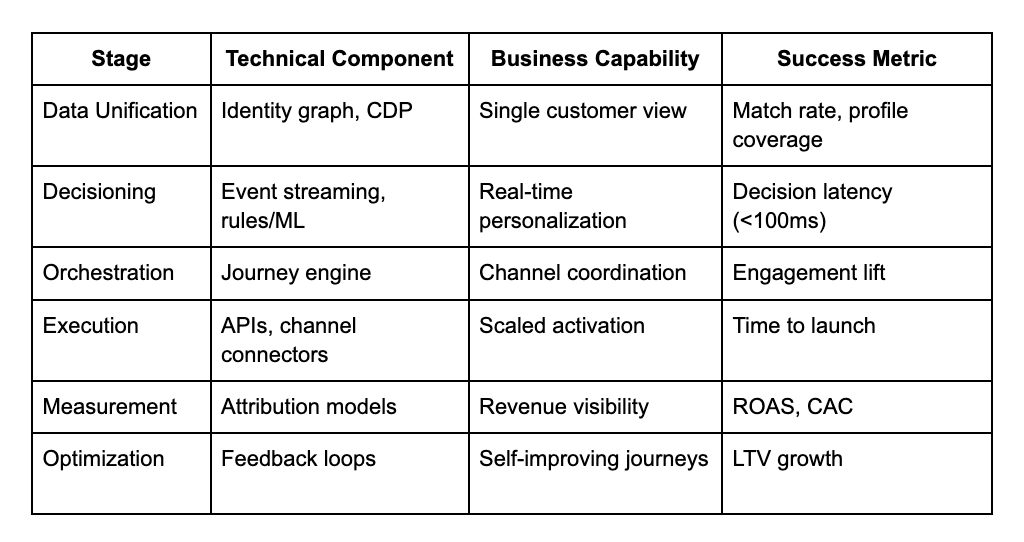
Data unification & identity resolution
Customer data, which comes from your CRM, core banking apps, CDP, ad platforms, and product systems needs to be unified into a persistent profile using deterministic and probabilistic identity matching. Without it, marketers can’t eliminate duplicate targeting, unlock accurate reach, or reach out with the proper frequency.
Real-time event processing & decisioning
Event streaming pipelines need to ingest customer behavior signals (logins, transactions, app events) in real time and route them to a decisioning engine with sub-100ms latency. That way, next-best-action decisions happen while intent is still live.
Journey orchestration & channel coordination
Rules, ML models, and suppression logic should work together to coordinate journeys across email, SMS, push, paid media, and call centers. Why? Because channel fatigue drops and engagement lifts as customers receive fewer, but more relevant messages. The Trade Desk found that this strategy reduced cognitive fatigue by 2.2x.
Cross-channel execution (owned & paid)
Customer journeys should activate simultaneously across ESPs, mobile, DSPs, and on-site personalization tools so marketers can significantly decrease the time it takes to launch campaigns, with some estimates of marketing productivity improvements of 35-45%.
Closed-loop measurement & attribution
Multi-touch attribution windows can help connect media exposure to downstream revenue and product usage, helping marketers see which omnichannel campaigns are working (and why).
Continuous optimization loops
Performance data needs to feed back into models and rules to automate testing and refine ongoing omnichannel campaigns. As rules and models get more precise, the right message gets to the right people more of the time, decreasing CAC and increasing LTV.
Here’s a table to help you organize your launch:
Data Unification and Real-Time Decision-Making
Enterprise-level omnichannel automation starts with ingesting data from CRM, CDP, POS, e-commerce, mobile apps, call centers, and ad platforms to construct a unified customer profile. Deterministic identifiers (like login and account ID) and probabilistic signals (like device type and behavior) form an identity graph that connects anonymous and known interactions across channels. This profile feeds a real-time decisioning engine, operating with sub-second latency.
Decisioning engine capabilities include:
- Real-time scoring on live events
- Next-best-action selection via rules + ML
- Channel preference and suppression optimization
- Offer and message personalization at scale
Unified data reduces wasted targeting, sometimes by up to 20-30%.
Orchestration, Channel Execution, and Suppression Logic
Customer journey builders coordinate messages across email, SMS, push, in-app, web, call center, chatbots, and paid media while enforcing frequency caps, channel preferences, and suppression rules.
Suppression is sometimes needed in critical scenarios, like pausing digital campaigns after POS pt (SLA) requirements, including message delivery latency targets, uptime guarantees, andurchases, cross-channel deduplication to prevent redundant messaging, save money on paid ads (you don’t want to waste it on people who already haven’t responded to your content or have already purchased straight from an ad), respect consent and privacy preferences in real-time.
Successful enterprise orchestration often requires that you meet and cover Service Level Agreemen failover protocols during peak traffic events.
Core orchestration controls include:
- Frequency capping across channels
- Channel prioritization rules
- Time-zone-aware delivery
- Sentiment-based routing
- Cross-channel suppression and consent enforcement
Why Enterprise Omnichannel Automation Matters
Enterprise-level omnichannel automation delivers CFO-level accountability by linking every marketing dollar to verified financial outcomes. Closed-loop measurement ensures boards can see provable ROI, connecting campaigns directly to revenue, funded accounts, or completed transactions.
Here are three measurement practices that drive optimization:
- Incrementality testing: Use holdout groups to prove causal lift from campaigns.
- Multi-touch attribution: Quantify each channel’s contribution across the seamless customer journeys.
- Real-time transaction verification: Tie spend directly to completed actions.
Implementing these practices typically drives ROAS improvement, CAC reduction, and increases in customer lifetime value. In fact, businesses using automation see about 25% higher marketing ROI on average.
Core Components and Technical Capabilities for Enterprise Readiness
Enterprise-scale omnichannel automation requires technical capabilities that are now table stakes for large financial institutions. Customer expectations include platforms that go beyond monolithic suites, favoring API-first, composable architectures that integrate with CRM, CDP, mobile apps, call centers, and ad platforms while delivering measurable business outcomes.
The shift to API-first architectures enables flexible integration, faster deployment, and real-time personalization without vendor lock-in, which is critical for FIs balancing speed, compliance, and scalability.
Five core technical capabilities and business enablement:
- API-first integration: Webhooks, REST endpoints, event streams. Enables rapid, low-friction connections to all enterprise systems.
- Real-time event processing: Stream computing for sub-second decisions. Drives personalized experiences and higher conversion.
- Enterprise security & compliance: SSO, RBAC, SOC 2, PCI. Reduces risk and satisfies audit requirements.
- Advanced segmentation & targeting: Behavioral and contextual segmentation. Improves campaign relevance and ROI.
- Unified analytics & attribution dashboard: Single pane for multi-channel measurement. Enables verified ROI and executive reporting.
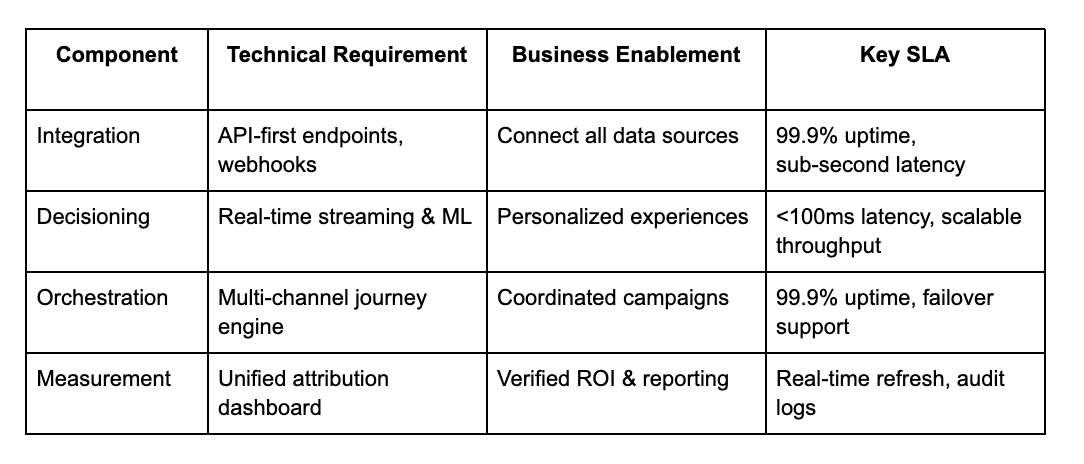
Platforms with these capabilities reduce operational friction, improve targeting and personalization, ensure regulatory compliance, and provide audit-ready proof of impact.
Targeting, Segmentation, and Personalization Engine
Enterprise omnichannel segmentation has evolved from static demographics to dynamic, real-time behavioral targeting. Modern platforms create unified, auto-refreshing segments that adapt as customers interact across channels, enabling highly personalized experiences.
Advanced segmentation capabilities and outcomes:
- Behavioral RFM scoring: Recency, frequency, monetary value to drive higher conversion.
- Predictive propensity models: Churn risk, upsell likelihood to enable CAC reduction.
- Real-time contextual triggers: Cart value, browsing behavior, geolocation to yield higher engagement.
By leveraging behavioral, predictive, and contextual segmentation, marketing moves from spray-and-pray campaigns to precision, increasing revenue and reducing wasted spend.
Integration Architecture and Governance Framework
Enterprise-grade governance is non-negotiable for FI and fintech marketers because it ensures campaigns comply with privacy regulations and internal security policies while still giving marketers the data they need to design smarter campaigns. Platforms must integrate seamlessly with existing martech stacks through native connectors or flexible APIs, supporting tools like Segment, mParticle, Salesforce, and Adobe.
Core governance controls include:
- Channel-specific consent management for GDPR, CCPA, TCPA, CAN-SPAM, CASL compliance
- Approval workflow engine with role-based campaign sign-offs
- Comprehensive audit logging for regulatory accountability
- SSO and RBAC to enforce secure access
Industry Applications and Vertical Use Cases
Enterprise omnichannel automation is driving measurable ROI in fintech, retail, and QSR, with these verticals leading the way in sophisticated cross-channel orchestration. By leveraging real-time, verified transaction data, organizations can suppress redundant messaging after offline conversions, ensuring relevance while protecting the omnichannel customer experience.
Verified offline data like POS transactions, card-on-file updates, or store visits, unlock true omnichannel orchestration, letting marketers connect digital outreach to in-person or financial events, closing the attribution loop, and enabling precise budget allocation.
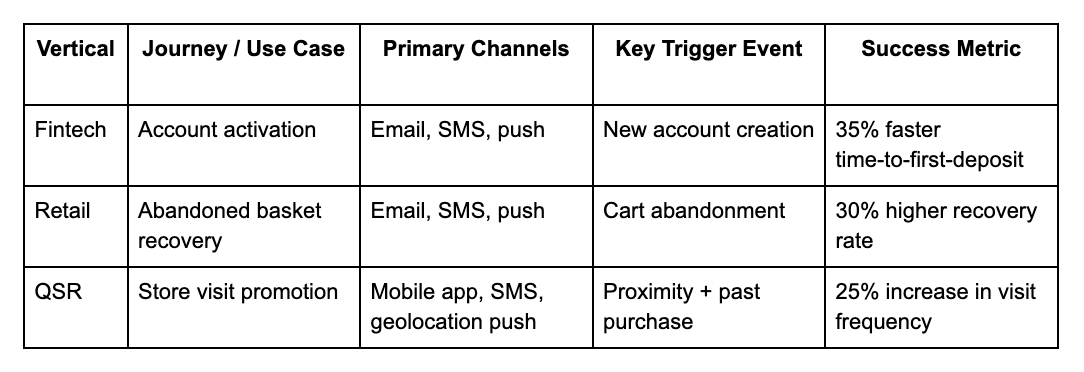
These vertical-specific journeys demonstrate how enterprises convert automation into bottom-line growth: faster onboarding and activation in fintech, and higher basket recovery and store traffic in retail/QSR. Using verified transaction data ensures campaigns are personalized to users, non-redundant, and measurable.
Banking and Fintech Omnichannel Journeys
Enterprise fintech success depends on how the customer lifecycle is orchestrated, from onboarding to retention and across channels with precision. This can turn new users into engaged, transacting account holders.
High-impact fintech journeys:
- Account onboarding & activation: Email welcome series, push, in-app tours → measure through activation rate, days to first transaction
- Card activation & first-swipe incentives: SMS + push with cashback offers → measure through % first-swipe rate
- Churn prevention & win-back: Targeted offers to dormant accounts → measure through reactivation rate
Orchestrating these journeys with real-time triggers and verified transaction data can help fintechs increase engagement, boost monthly active rates, and drive top-of-wallet share, while providing CFOs and boards with measurable ROI.
Retail and QSR Cross-channel Campaigns
Retail omnichannel automation should orchestrate online and offline interactions seamlessly, connecting e-commerce, POS, mobile apps, and loyalty programs to drive measurable business outcomes. Verified transaction data enables suppression logic, ensuring customers aren’t spammed after in-store purchases while maximizing engagement.
Some high-impact retail/QSR scenarios are:
- Cart abandonment with POS suppression: Email/SMS recovery flow stops if purchase detected → measure through recovery rate
- Store visit attribution & follow-up: Post-visit survey or incentive triggered by verified transaction → measure through repeat purchase lift
- Loyalty tier progression: Coordinated email, push, in-app messages celebrating tier achievements → measure through tier advancement engagement
Connecting digital and physical interactions can help retailers increase customer basket size, improve foot traffic, and drive repeat purchases. This turns omnichannel orchestration into measurable ROI.
Best practices for enterprise planning, testing, and optimization
Purchasing an enterprise omnichannel platform is just the first step—real transformation requires structured planning, disciplined execution, and continuous optimization. Without a clear roadmap, enterprises risk slow adoption, wasted spend, and underwhelming ROI.
Deployment guidance:
- Strategic planning: Build the business case, secure executive sponsorship, define success metrics upfront, and select pilot journeys. Clear goals reduce ROI uncertainty.
- Implementation approach: Use phased rollout, design an event taxonomy, establish QA protocols, and implement a Center of Excellence (COE) to maintain governance. Typical enterprise timelines are 2–4 weeks for initial integration and 3–6 months to scale full journey portfolios.
- Continuous optimization: Apply A/B testing frameworks, incrementality measurement cadence, data quality monitoring, and performance dashboards. Avoid common pitfalls: over-customization, lack of governance, underinvestment in data hygiene, and insufficient team training.
Strategic Planning and Deployment Checklist
Now it’s time to think about deploying your omnichannel automation. Here’s a checklist with steps on how to plan and execute your implementation:
- Build an executive-level business case with ROI projections.
- Define North Star metrics and KPI framework.
- Select 2-3 pilot journeys for proof-of-value.
- Design event taxonomy and data schema.
- Establish Center of Excellence and governance model.
- Implement phased rollout plan with clear exit criteria per phase.
Testing and Optimization Framework
You’ll also need to think about how to optimize your system. You can follow this 6-step optimization loop:
- Baseline measurement (pre-automation performance0
- Hypothesis formation (identify optimization opportunities)
- A/B test design with statistical rigor
- Incrementality validation via holdout groups
- Performance monitoring and alerting
- Iterate and scale winning variations. Emphasize testing cadence: weekly for tactical optimizations, monthly for strategic journey redesigns.
Common pitfalls include insufficient sample size, testing multiple variables simultaneously, declaring winners too early. Following this loop enables enterprises to drive measurable lift like 44% higher new-customer spend.
Kard’s Card-linked Offer Platform Has Omnichannel Infrastructure
Kard’s CLO platform is a strategic omnichannel layer that integrates seamlessly with enterprise marketing stacks to activate first-party transaction data. Its API-first architecture enables quick deployment so banks and fintechs can start driving verified engagement quickly.
Key enterprise differentiators:
- Real-time transaction verification: Enables closed-loop attribution, proving which campaigns drive revenue.
- Merchant-funded economics: Performance-based pricing reduces upfront marketing spend.
- Access to 61M+ cardholders: Leverage placements inside banking apps for incremental engagement.
- Unified analytics dashboard: Provides transparent, actionable insights across campaigns.
- Privacy-compliant first-party data activation: Ensures regulatory alignment while powering personalization.
Want to see how Kard can elevate your omnichannel campaigns?
Check out our case studies or schedule time with our team to see the value of commerce media firsthand.
Frequently Asked Questions About Enterprise Omnichannel Automation
How does enterprise-level omnichannel automation differ from traditional marketing automation platforms?
Enterprise-grade omnichannel automation platforms go beyond batch email campaigns and basic customer journeys. They unify real-time customer data across online and offline touchpoints, activate it instantly through rule-based or AI-driven decisioning, and deliver closed-loop attribution tied to transactions, not clicks. Traditional marketing automation systems are often limited to channel-specific workflows and delayed batch processing, which leads to fragmented personalization and unverified ROI.
What ROI metrics should we expect, and how do they compare to traditional campaigns?
Organizations that deploy enterprise-level omnichannel automation typically track:
- Customer acquisition cost (CAC) reduction: 20 to 30% from improved targeting and suppression
- Customer lifetime value (CLV) lift: 15 to 25% through better retention and upsell journeys
- Return on ad spend (ROAS) uplift: 30 to 50%, especially in campaigns with verified holdouts
Plus:
- Incremental revenue from causal-impact-tested campaigns
- Operational efficiency gains, such as reduced manual campaign work and fewer redundant sends
Unlike traditional metrics that focus on opens and clicks, these tie directly to spend, purchase behavior, and margin.
What’s a realistic timeline to implement omnichannel automation at the enterprise level?
Expect a phased rollout where:
Weeks 1 to 4: You’re focused on data mapping and API integrations. You might pilot use cases in 1 or 2 channels.
Months 2 to 3: You start adding more customer journeys and testing attribution models.
Months 4 to 6: Are for full journey orchestration across email, SMS, in-app, paid media, and direct mail.
Really, your timeline will depend on internal data readiness and the ability to unify systems (e.g., CDP, CRM, POS, ecommerce).
How do enterprise omnichannel systems manage compliance across global regulations?
Modern omnichannel platforms include centralized consent management, per-channel preferences, and real-time audit logs that help teams enforce GDPR, CCPA, TCPA, CAN-SPAM, and other global data privacy standards. Features like role-based access controls (RBAC) and purpose-limited processing help meet both legal and brand trust requirements.
What’s the most accurate attribution model for omnichannel campaigns?
Enterprise-grade platforms use closed-loop attribution based on transaction verification and holdout experiments. This approach measures causal impact (not just correlation) by comparing behavior in exposed vs. control groups. It avoids the biases and guesswork of traditional last-touch or multi-touch attribution, which struggle to account for cross-channel and offline conversion paths.
How do these platforms integrate with CDPs, CRMs, and broader martech stacks?
Look for API-first platforms with pre-built integrations for systems like Salesforce, Segment, Adobe Experience Platform, and your core data lake or warehouse. Leading enterprise automation tools offer event-driven architecture, real-time sync, and bidirectional data flows, so activation and analytics stay tightly coupled, without manual file swaps or brittle workflows.