
The way Gen Z gets from “I want that” to “I bought that” looks nothing like a traditional funnel. Their path to purchase is fragmented, channel-heavy, and full of detours. Capital One Shopping Research finds shoppers interact with brands in an average of six touch points in their typical purchase journeys.
Finding out what those detours are and capitalizing on them is critical: Gen Z is on track to become the largest, wealthiest, highest-spending generation in history, reaching $12.6 trillion in total spend by 2030.
Here’s what those touchpoints look like and how that should shape your future marketing strategy.
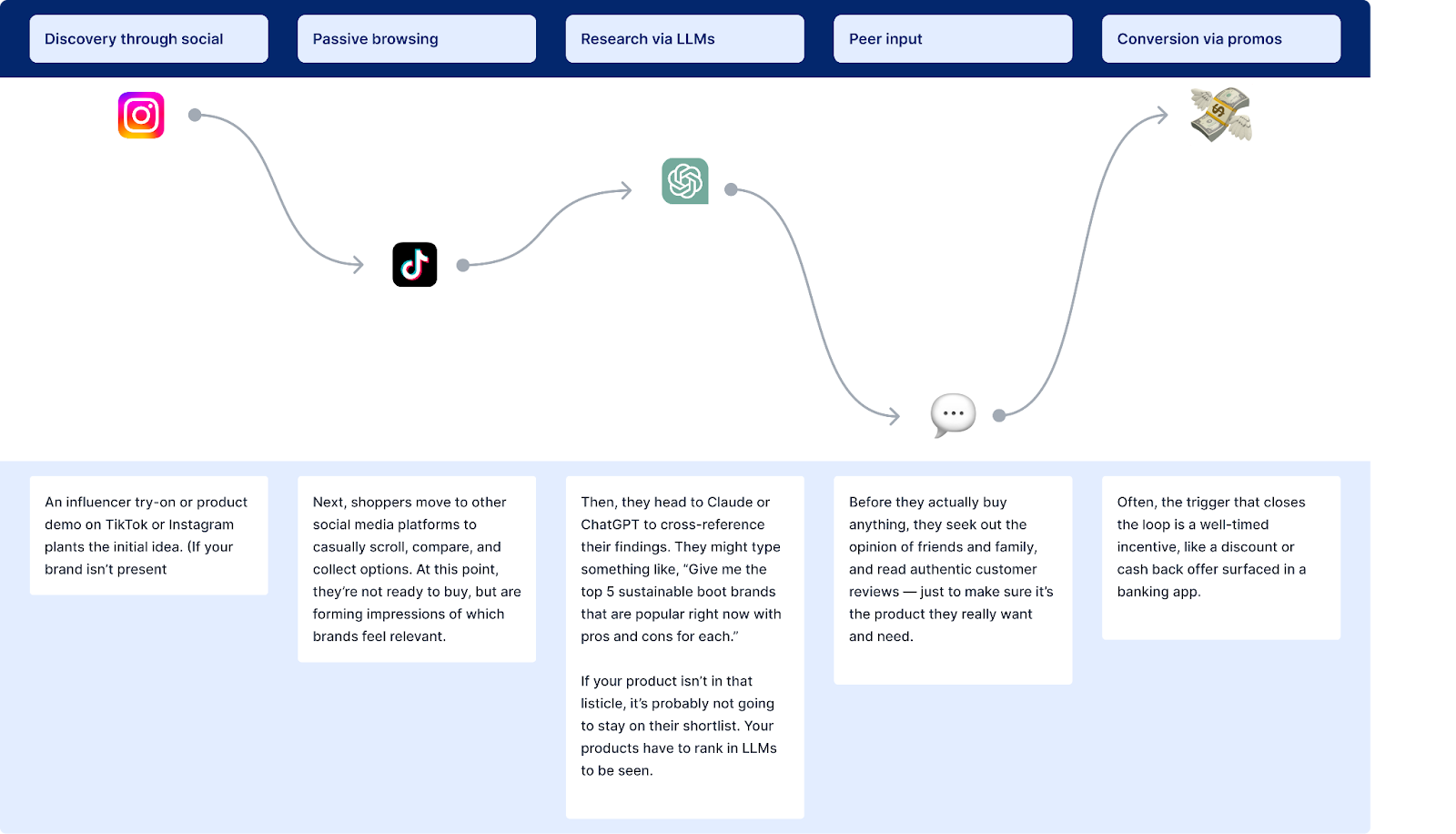
Step 1: Discovery through social
An influencer try-on, a product demo, or a haul video on Instagram or TikTok (maybe even a mention in someone’s favorite Substack) plants the seed.
According to a PYMNTS Intelligence report, 81% of Gen Z sometimes or often make purchases based on influencer recommendations on social media — compared to just 28% of baby boomers.
If you’re not already engaging with affiliates or getting your brand attention on these social channels, you’re missing out on the earliest chance to get on their radar.
Step 2: Passive browsing
At this point, they’re not in buying mode — just getting a sense of what brands (and other influencers) are worth paying attention to: bookmarking certain posts, following review accounts. But they’re open to new ideas, and that’s where you position your brand as one that’s cool, fun, or extremely useful to try.
McKinsey reports that half of US Gen Z consumers are open to exploring new brands, and are five times more likely than older generations to believe that newer brands are “better or more innovative” than established brands.
A brand that shows up consistently across multiple channels — with a message that makes your brand seem new and exciting — has a meaningful head start over one that only appears in select channels with the same old copy and creative.
Step 3: Research via LLMs
Before buying, younger consumers increasingly turn to AI tools like Claude and ChatGPT to cross-reference their options.
In fact, 44% of Millennials and 42% of Gen Z said they were likely to use chatbots and AI tools for holiday purchase inspiration last year. And companies like OpenAI are jumping on this trend, launching ads and partnering with Shopify.
If your boot company isn’t showing up in results for a “Give me the top 5 sustainable boot brands right now with pros and cons for each” prompt, you may not make Gen Z’s shortlist (regardless of how well you rank on Google or how much you've spent on display).
Step 4: Peer validation
Before committing, they ask friends and family, but they also take to Reddit and read customer reviews.
Research from Syracuse University and Thomson Reuters found that 81% of Gen Z consumers have changed a purchase decision based on a brand's actions or reputation. By this stage of the journey, the perception your brand has built across steps 1 through 3 either holds up under scrutiny or it doesn’t.
Asking customers for reviews, working with influencers, and promoting user-generated content can help. So can adjusting your creative. Chris Bajda, Founder of Groomsday, reoriented his ad creative entirely around how younger buyers validate purchases:
“Rather than placing a monogrammed flask with a typical discount callout, I created a video short that depicts three groomsmen using it on a tailgate and then at a backyard wedding rehearsal. The ad is framed as a ‘how to get more use out of one gift’ story, so the audience sees value before price.”
That shift increased his click-through rates by 28%.
Step 5: Conversion via a well-timed offer
According to PwC’s five-year Gen Z study, just 21% regularly pay full price. That means they’re hungry for a deal, and rewards are the way to go.
Research from PayPal and Reach3 Insights found that 81% of shoppers make purchase decisions based on rewards, and an IPSOS survey found that 70% of Americans prefer to pay by card specifically to earn rewards or points.
Kard’s data shows what well-timed, targeted offers look like in practice. A footwear brand gained 35% more market share with a 5% cash back offer. A clothing retailer drove 167% week-over-week revenue growth through a campaign targeted at Gen Z and younger Millennial consumers within three months.
What our data tells brands about when and where to show up
Understanding the journey is one thing. Knowing when younger consumers are actually spending (and on what) is another.
We analyzed $70B worth of transaction data last year. Here are the main stats worth building into your strategy:
Weekday spend is significantly higher than weekend spend
Across Kard's network, average daily spending among Gen Z and Millennial cardholders was 46% higher on weekdays than weekends in 2025 — up from 27% 2024.
In categories like financial services, entertainment, travel, and health and wellness, the weekday skew is even more pronounced.
What to do: If you operate in this category, you’d benefit from day-specific promotions and rewards-based offers to encourage consumers to buy online or in-store.
Consider optimizing when these ads are shown, perhaps on Sunday or Monday, to drive purchases during the week. Department stores and specialty retailers, on the other hand, should prioritize weekend customer experience.
Time it right, and you’ll hit younger buyers with the right discount when they're most active.
Big box dominates volume, but discretionary categories carry the AOV
In Kard's dataset, big-box retailers accounted for 20% of total spend.
But the average order values in discretionary categories tell a different story about where there's room to compete. Travel, sporting goods, home improvement, fashion, home goods, department stores, and beauty all carry a high AOV among our Millennials and Gen Z network.
That matches with external data, too. McKinsey’s ConsumerWise research found that, on average, 65% of Gen Zers say they are willing to splurge in the categories that matter to them. In every country surveyed (18 in total), Gen Z was the highest-spending generation.
What to do: Figure out (1) what makes your product “splurgeable” — aka very cool, valuable, and desirable — and (2) how to encourage that splurge. Here are two ways to do it:
- Partner with discount stores. Shoppers trust that they’re getting a good deal at places like Dollar General (ranked in the top 20 in total merchant spend) and Family Dollar (in the top 70). If they already feel like they’re saving on everything else in store, they might be willing to pay a bit more for your product — and will keep coming back if they feel the value is there.
- Offer cash back rewards. A 3 to 5% cash back offer can be the difference between a consumer clicking “Place Order” and letting high-value products sit in their cart until they see a better promo.
Convenience is a given, rewards make you stand out
Today, a whopping 85% of younger consumers report using at least one convenience service. And that showed up in our data:
Quick serve restaurants (8%), gas & convenience (8%), and transportation (6%) account for 22% of total cardholder spend.
What to do: Digital-first consumers value convenience and are definitely willing to buy goods and services that make their lives easier — PYMNTS found people who aren’t living paycheck to paycheck are willing to spend over $200 (average of $237) per month on convenience.
But if every brand is competing on convenience, how can you stand out?
One way to pull ahead is to offer a diminishing discount structure — 15% off on a first purchase, 10% on a second, 5% on the third. Blake Ziolkowski, Kard's Senior Director of Merchant Sales, comments:
“We’ve seen that a tiered rewards structure not only encourages repeat purchases, but also gets you higher average order values.”
Meet Gen Z where they are
The non-linear buying journey isn't a quirk. It's how Gen Z shops, and it's the model younger Millennials are increasingly adopting too. Brands that understand each stage — and build timing, channel, and offer strategy around real spend data rather than assumptions — are the ones taking share right now.
Want to attract more Gen Z consumers?
Kard’s network is 58%+ Gen Z.
See how cash back rewards can get you in front of that audience and convert them with the right offer at the right time. Schedule a demo today.