Commerce media is fundamentally changing how digital advertising works — not by adding yet another channel, but by shifting the focus from reach and awareness to actual outcomes.
As marketers face pressure to prove performance, commerce media is a way to connect targeted ad spend directly to business results. And by 2029, eMarketer predicts commerce media will represent close to a quarter of advertisers’ digital media budgets in the US.
In this guide, we unpack what commerce media actually is, why it’s all the rage right now, and how to hop on this trend early to level up your performance marketing before your competitors do.
Understanding Commerce Media: The Foundation of Modern Advertising Strategy
Commerce media is a form of digital advertising that reaches consumers in environments where they’re actively shopping, checking out, or transacting.
Commerce media networks sound a lot like retail media networks — the on-site and in-app ad platforms built by Amazon, Walmart, and Target. These networks are a major part of the shift marketers are making toward performance-driven, outcome-based media, but they’re just one piece. Commerce media has expanded well beyond RMNs, spanning a much broader set of transaction-driven platforms, like:
- Banking and credit card apps
- Digital wallets and payment platforms
- Loyalty and rewards programs
- Marketplaces
- Travel booking sites
- Food delivery and mobility apps like Instacart or Uber
And as third-party cookies disappear and marketers face growing pressure to prove ROI, commerce media expands your reach and ties ad exposure directly to measurable outcomes.
- It reaches people who are ready to buy — people who are actively browsing, booking, or checking out.
- It uses real, verified commerce data. Discounts, promos, and rewards are surfaced based on consumers’ actual purchase behavior.
- It’s measurable by design. Because sponsored ads run in closed-loop ecosystems, you can track spend to sales, including lift, loyalty impact, and even SKU-level detail.
Commerce media gives marketers what most channels can’t: precision, scale, and proof. Platforms like Kard are already giving merchants a scalable channel to engage consumers and link brand exposure directly to verified online and in-store purchases. That’s why McKinsey projects the US commerce media market will exceed $100B in the next year. It delivers personalized ad impact you can actually measure.
The Strategic Shift: How Commerce Media Ecosystems Are Transforming Advertising Planning and Execution
Instead of relying on awareness-heavy funnels or generalized KPIs, commerce media forces marketers to rethink:
- Campaign goals. Unlike traditional performance marketing campaigns, your goal isn’t to boost impressions. Because, in some cases (for example with Kard) those are free. Instead, your goal is to increase incremental ad revenue and new-to-brand acquisition. Over time, this kind of online advertising should drive higher AOV and repeat purchase behavior — but it can even increase in-store behavior, depending on your reward strategy (e.g. get 15% on cash back in-store purchases vs. 5% cash back on online purchases). That’s a huge boon for retailers who are trying to fill in the gap in full-funnel strategies. As Amy Vollet, SVP of commerce and media at Saatchi X, explained during a panel at Advertising Week New York, “The pendulum is starting to swing back [to in-store]. They need to differentiate to close the deal.”
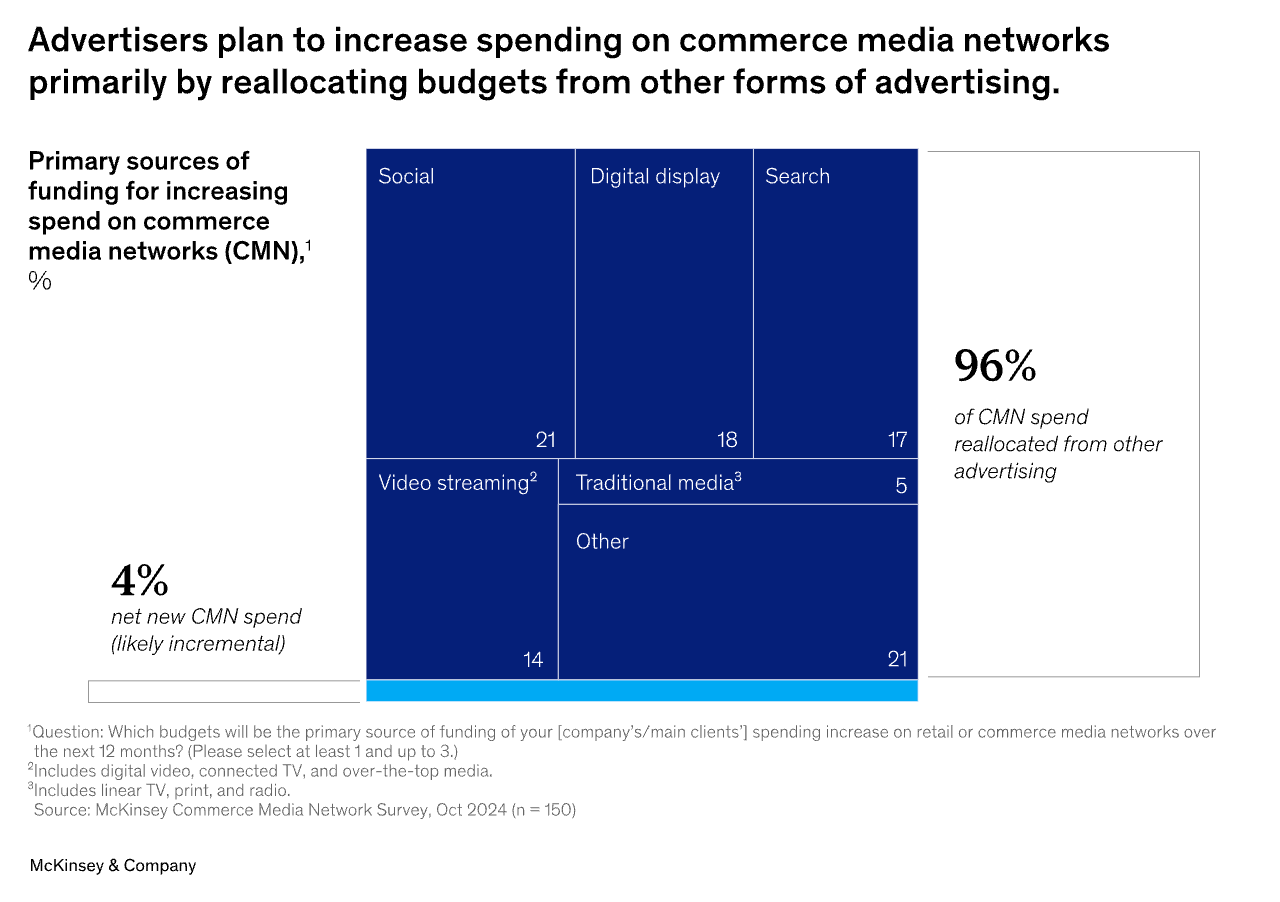
- Budget. To take advantage of a captive audience, marketers are increasingly reallocating budget toward commerce media. According to McKinsey, 55% of marketers say they will increase their overall commerce media budget in the next year. 21% plan to shift their budget from social media, 18% from digital display, and 17% from search ads. As more retail media and commerce platforms offer outcome-based pricing models, more and more marketers are seeing the value.
- Channel mix. Commerce media doesn’t replace your upper-funnel tactics, but it does force them to work harder. Teams are rebalancing spend to support both brand-building and conversion-driving touchpoints, often within the same campaign ecosystem. For example, Instacart’s platform lets CPG brands run awareness, consideration, and promotion units across a shopper’s full path to purchase, all in one place.
- Timing. Commerce media placements thrive on intent signals, like seasonality, entering a loyalty portal, or checking their card balance. Sending an ad or reminding them of a cash back reward they have when they’re in a specific mindset helps maximize conversion. Brands pursuing commerce media need to constantly be thinking about how they can adjust their language and messaging to fit consumer touchpoints.
Implications for Modern Marketing Teams
Teams that succeed with commerce media are revisiting how they brief campaigns, how they structure reporting, and even how they collaborate across marketing, media, and merchandising. That starts with:
- Cross-functional collaboration. Media, brand, performance, loyalty, and even in-store teams need to align on shared outcomes, particularly as commerce media spans both physical and digital touchpoints.
- Upskilling. Performance marketers need to understand loyalty and commerce data. Media buyers need to get fluent in SKU-level measurement. Creatives need to develop assets that flex for both upper-funnel storytelling and lower-funnel conversion triggers.
- Reporting changes. You’ll need tools that support experimentation, closed-loop attribution, and outcomes that move the business, not just the metrics.
First-Party Customer Data and Targeting Precision: The Commerce Media Advantage
Unlike traditional digital advertising that often relies on inferred or probabilistic signals, commerce media taps into real transaction behavior. That first-party data can fuel powerful segmentation.
Want to target based on past purchases, frequency, spend levels, brand loyalty, or even time since last transaction?
Want to reach lapsed shoppers with a tailored offer?
Want to promote high-margin SKUs to frequent buyers?
Want to upsell adjacent products based on a recent purchase?
All of that becomes possible when you’re working with purchase-based data. Plus:
It Makes Your Lookalike Models Sharper
Amazon and Walmart Connect allow retail media advertisers to build lookalike audiences based on purchasers of a given SKU, category, or brand.
Other independent commerce media platforms and loyalty apps like Fetch enable lookalike modeling based on anonymized purchase behavior (i.e., finding users who shop similarly to those who redeemed a specific offer). You could even tailor promotions down to the merchant or category level — in a way that’s privacy-compliant and fully trackable.
It Supports Smarter Retargeting
A consumer who bought a flight last week can be shown a hotel deal today. A shopper who claimed an offer for coffee can be prompted with a pastry discount tomorrow. Timing, relevance, and context all improve when you’re operating within a closed-loop, commerce-driven system.
Crucially, all of this happens without relying on third-party cookies. Commerce media channels are built on logged-in users, opt-in rewards programs, and authenticated transactions, giving marketers targeting power that’s both precise and future-proof.
Measurement and Attribution in Commerce Media: Closing the Loop Between Ad Spend and Sales
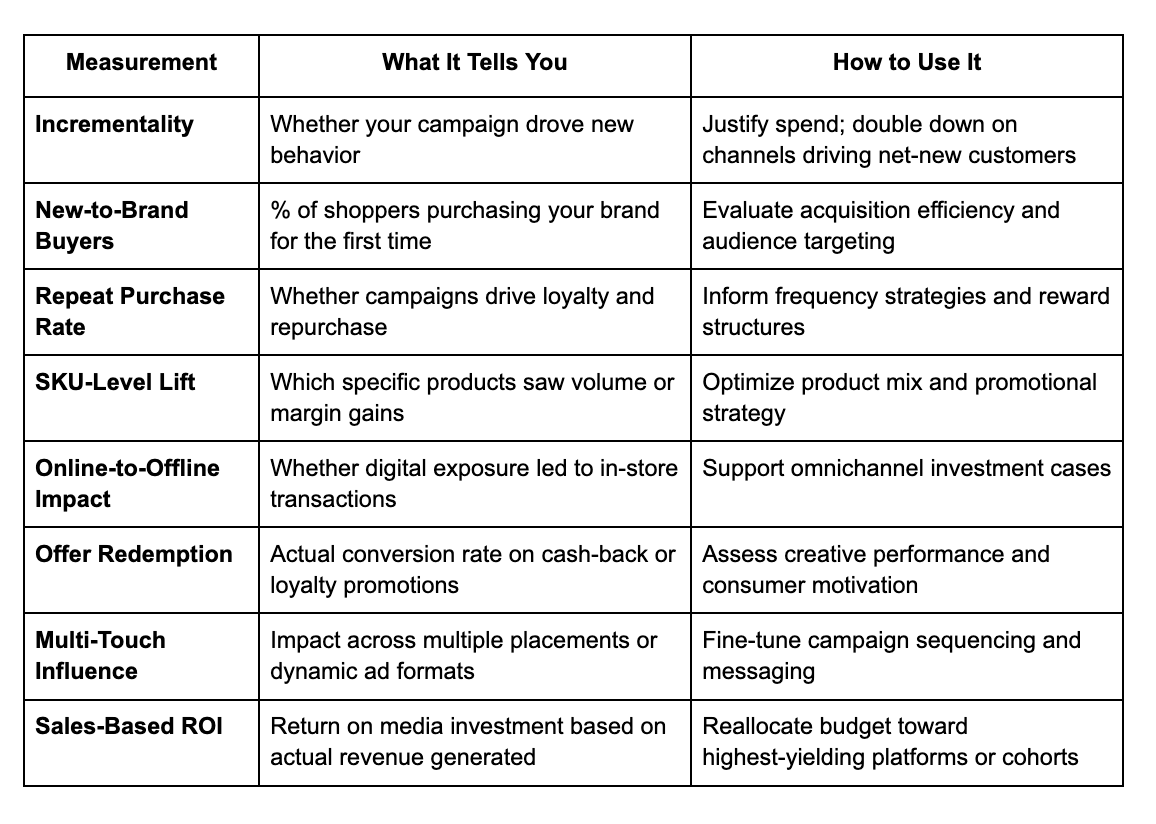
Because ads run in closed-loop ecosystems, marketers can finally measure outcomes, not just activity. Think incremental ad revenue, new-to-brand buyers, repeat purchase rates, and offer redemptions tied directly to a campaign.
Platforms that use card-linked offers or loyalty-based rewards make it even easier to connect digital exposure to online or in-store spend. That opens up high-quality metrics like:
- Online-to-offline attribution (Did they see an ad format and shop in-store?)
- SKU-level lift (Which product saw a volume or margin bump?)
- Campaign incrementality (Did this drive new behavior—or just catch a shopper on their usual path?)
- Multi-touch effectiveness (Did different ad formats influence the final purchase together?)
Holdout testing and built-in control groups are becoming standard across many commerce media platforms, too, giving marketers the clarity they’ve lacked in traditional performance media.
Implementation Strategies: Integrating Commerce Media into Your Advertising Mix
Here’s how to integrate commerce media into your advertising mix, one step at a time:
1. Build Internal Alignment
Commerce media often sits at the intersection of media, loyalty, and performance marketing. Make sure your teams are working from the same playbook, with shared KPIs and attribution models.
2. Allocate Budget
Most marketers start by shifting 10 to 15% of their digital media budget into commerce media, often pulling from display or social (as we talked about above). Work with other teams to agree on an initial mix — you can always change it later as you scale.
3. Choose the Right Partner
Start by identifying commerce media platforms that align with your goals. Some give you deep reach in their ecosystems. Others, like Kard, offer broader reach across merchants and categories. Match the partner to the outcome: in-store lift, new customer acquisition, loyalty, or cross-sell.
4. Adjust Your Creative
Commerce media thrives on clarity and value exchange. Ads should highlight the benefit, whether it’s cash back, a % discount, or loyalty points. And it should drive immediate action through urgency (expiration dates, seasonal items, etc.). Consider modular creative that can flex across merchants, SKUs, or audience segments.
Read about our “Relevant, Simple, Urgent, Consistent” framework for rewards here.
5. Run a Pilot
Begin with a controlled test. Choose a single audience or region and define what success looks like (incremental sales, offer redemption, new-to-brand customers). Run your campaign for a few months to give it some time to reach the right audience.
Did you hit your success metrics? How do the results compare to other campaigns you’ve run before? Work with your commerce media partner to find the sweet spot. They should be able to suggest ways to adjust your reward amount, ad copy, and design.
Remember: different brands, different plays. CPG brands may chase in-store lift. DTCs may prioritize customer acquisition. Regardless of your vertical, commerce media gives you a new lever to drive outcomes you can prove.
Emerging Trends and the Future Evolution of Commerce Media Advertising
Commerce media is evolving fast. Here’s what to watch:
1. Expansion Beyond Retail
Commerce media isn’t just for retailers anymore. Travel platforms, fintech apps, ride-sharing services, and food delivery marketplaces are all building ad products that monetize high-intent moments.
2. AI-Driven Optimization
From predictive audience modeling to dynamic offer personalization, AI and machine learning is helping marketers match the right message to the right moment, and drive higher ROI with less manual effort.
3. Connected TV
Retail media platforms like Kroger and Walmart are already integrating with streaming platforms to enable commerce-driven CTV campaigns, so expect to see more shoppable ad units in other commerce media platforms, too. These can help bridge upper-funnel attention with lower-funnel conversion signals.
4. Social Commerce
Social platforms are increasingly embedding checkout, loyalty, and offer mechanics into native ad units. The line between content and commerce is blurring and performance marketers will need to adapt their creative and attribution strategies accordingly.
5. Immersive Formats and Emerging Interfaces
Voice commerce, augmented reality, and conversational AI are beginning to create shoppable moments beyond the screen. While still early, these channels will expand the definition of “commerce ready” media environments.
You Need a Commerce Media Strategy
Commerce media isn’t just a trend. Banking giants like Mastercard and Amex launched their own platforms earlier this year, signaling that this model isn’t limited to retail giants anymore.
But those networks only see a slice of a shopper’s world. Independent commerce media networks, like Kard, aren’t tied to a single retailer.
We have 47M+ cardholders in our network who buy at hundreds of different merchants. That breadth gives marketers a 360-degree view of their customers’ shopping patterns, and lets them send hyperpersonalized cash back offers that prove incremental impact at scale.
Marketers who get in on commerce media networks like these now get direct access to high-intent audiences before commerce media becomes the norm. eMarketer predicts commerce media will represent close to a quarter of advertisers’ digital media budgets in the US by 2029.
Curious about how an independent commerce media network like Kard can give you a competitive advantage?
Book time with our team to see the platform in action.
Commerce Media & Online Advertising Strategies FAQs
What is commerce media, and how does it differ from traditional online advertising?
Commerce media is advertising delivered in transaction-rich environments like retail media networks, online marketplaces, and card-linked platforms.
Unlike traditional digital ads that focus on impressions or clicks, commerce media targets users at or near the point of purchase, using first-party, deterministic data to drive measurable outcomes. It emphasizes closed-loop attribution, where exposure and conversion occur within the same ecosystem. This makes it a fundamentally performance-driven channel that prioritizes ROI.
Why is commerce media becoming more important in advertising strategies?
Commerce media is gaining traction because it’s linking advertising investment directly to actual sales, both online and offline. As third-party cookies phase out and brands prioritize privacy-compliant targeting, commerce media offers a reliable, data-rich alternative.
Industry forecasts predict U.S. commerce media spending will exceed $100B by 2027, driven by demand for outcome-based marketing and budget reallocation from traditional display and social channels.
How does commerce media improve targeting compared to other digital channels?
Commerce media uses first-party transactional data, such as purchase history, loyalty activity, and shopping behavior, to create highly accurate audience segments.
This deterministic data allows for precise targeting, including look-alike modeling and retargeting based on cart activity or product preferences. Because ads are delivered in logged-in or opt-in environments, targeting remains effective while staying privacy-compliant, outperforming cookie-based methods.
How can advertisers measure ROI from commerce media campaigns?
ROI in commerce media is measured using closed-loop attribution, where ad exposure and sales data are directly linked within the same platform.
Advertisers can evaluate results by SKU, store, region, or audience, and many networks offer dashboards with metrics like incremental sales and new-to-brand conversions. Advanced strategies like holdout testing and clean-room analytics provide further clarity on incremental impact, helping brands make smarter budget decisions.