
It’s important to have a cohesive omnichannel marketing strategy to reach customers wherever possible and to streamline your outreach and data analytics.
How do you actually do this, though, especially when your marketing campaigns utilize multiple channels that operate on different platforms?
Omnichannel integration connects these marketing channels and unifies customer data. Read on for more about how to structure omnichannel integration, industry-specific use cases, and implementation frameworks needed to consolidate your stack for measurable performance gains.
Introduction to Omnichannel Integrations in B2C Tech
Those running marketing campaigns across five or more channels (email, SMS, push, in-app, web, paid media, and so on) face a familiar set of challenges: channel sprawl, data silos, poor attribution, and fractured customer journeys. Without a centralized way to understand and act on customer behavior, budgets leak, experiences feel disjointed, and it becomes nearly impossible to know which touchpoints actually drove conversions.
At its core, omnichannel integration for B2C marketing tech isn’t really about adding more channels, but more about connecting them. Omnichannel integration means implementing API-first, consent-safe infrastructure that unifies customer data, orchestrates journeys across touchpoints in real time, and enables closed-loop measurement across acquisition and retention. This unified layer dissolves silos, which lets you track behavior from an email click to an in-app purchase, both of which can be tied back to revenue.
Because omnichannel experiences keep your brand top of mind wherever the customer interacts. Customers could be browsing through cash back offers or opening push notifications, for example. But regardless of what the specific interaction is, brands see measurable business impact.
Omnichannel integration is also great because it unifies customer journeys, which reduce churn, boost cross-sell and up-sell rates, and strengthen customer loyalty in a highly competitive landscape where consumers expect seamless experiences across channels.
Consider cash back programs as an omnichannel integration example. When integrated via APIs, issuers can activate offers contextually in banking apps, SMS, or email, and merchants can access performance metrics like offer ROAS, redemptions, and average order value to optimize future campaigns, demonstrating how tightly integrated systems unlock insights and outcomes that segmented stacks can’t.
Omnichannel Integrations Architecture for B2C Stacks
To deliver reliable, scalable omnichannel marketing that keeps brands top of mind across every touchpoint, organizations must invest in a seamless integration stack. Modern consumers expect consistent experiences regardless of channel, yet disconnected tech stacks create fragmentation, slow innovation, and inflate operational costs. According to SAP Emarsys, brands that unify data and marketing channels report higher customer retention, loyalty, and margins, proving the strategic value of omnichannel integration.
A robust reference architecture ensures customer data flows smoothly from capture through activation and measurement while enabling observability, error handling, and extensibility via open APIs and event-driven connectivity. These capabilities are essential for marketers who must prove impact, optimize spend, and personalize at scale.
Seven Core Layers of Omnichannel Integration
- Data Capture: Ingest customer interactions in real time from web, mobile, and POS.
- Identity Resolution: Match identifiers across devices and channels to build unified profiles.
- Consent Management: Centralize privacy preferences (GDPR, CCPA), syncing with all other tools.
- Storage: Consolidate first-party data into a cloud data warehouse and/or CDP.
- Activation: Deliver messages via email, SMS, push, in-app, and advertising platforms.
- Orchestration: Coordinate journeys with rules, triggers, and frequency capping.
- Analytics: Attribute outcomes, analyze cohorts, and surface insights for optimization.
Each layer works in concert to move data from raw events to actionable insights and enhance customer engagement pathways, all of which reduces silos and increases ROI.
Data Capture Methods: Real-Time, Reliable, and Complete
The omnichannel strategy begins with data capture. Tools like web and mobile SDKs record events directly from customer behavior (like page views and feature usage), while server-side tracking ensures minimal data loss compared with client-side pixels, which can be blocked or dropped by ad blockers or browser privacy features.
Event streaming (Kafka and Segment) routes high-velocity data to downstream systems with low latency. Webhook subscriptions from platforms like Shopify deliver order and cart events in real time to orchestration tools. Physical touchpoints, such as POS APIs, feed in-store interactions into the same pipeline, enabling truly cross-channel personalization.
Without capturing complete, real-time interaction data, downstream personalization and attribution degrade. This leaves marketers chasing blind spots rather than optimizing experiences.
Storage and Identity: Single Customer View, Actionable Profiles
Once captured, customer data needs organization. CDPs and cloud data warehouses (Snowflake, BigQuery) unify data at scale, acting as the central repository for events, attributes, and transaction history. Identity resolution engines stitch together deterministic matches (email and customer IDs) and device behavior patterns to form unified customer profiles.
From there, reverse ETL pipelines push enriched segments back to activation tools, ensuring all systems work from the same single source of truth rather than fragmented datasets. This enables consistent personalization and reliable audience sync across channels.
Unified profiles and synchronized identity allows marketers to reduce duplicate outreach, improve personalization, and tighten measurement fidelity as opposed to running channels independently.
Activation & Orchestration: Seamless Omnichannel Execution
Activation tools like Braze or Iterable use REST APIs to ingest segments and trigger messages across email, SMS, push, and in-app. For paid media, conversion APIs send verified events back to ad platforms, improving attribution quality and lowering reliance on client-side cookies.
Orchestration layers ensure customers receive the right message at the right time without redundancy or fatigue. Marketers can define lifecycle campaigns that react to behavior in real time, maximizing engagement and reducing churn
Integrated activation and orchestration shrink the gap between insight and action, allowing for real-time personalization while protecting customer trust and consent preferences.
Reliability at Scale: Observability and Monitoring
To operate reliably at enterprise scale, teams need observability: centralized logs, dashboards, alerting, and retry logic for failed event deliveries. Pipelines should surface errors automatically and provide remediation paths without manual firefighting.
Sample Stack Reference Table

By mapping how data flows through these layers, marketers get a visual and practical understanding of how omnichannel integration gives them the speed, personalization, and measurement they need to succeed in today’s B2C landscape.
Strategic Value of Omnichannel B2C Integrations
Effective omnichannel integrations rest on three pillars: targeting and personalization powered by first- and zero-party data, an integration architecture that ensures reliability and interoperability, and measurement and attribution that connect spend to revenue. Together, these components are the “how” behind omnichannel impact.
Engagement Lift From Omnichannel Integrations
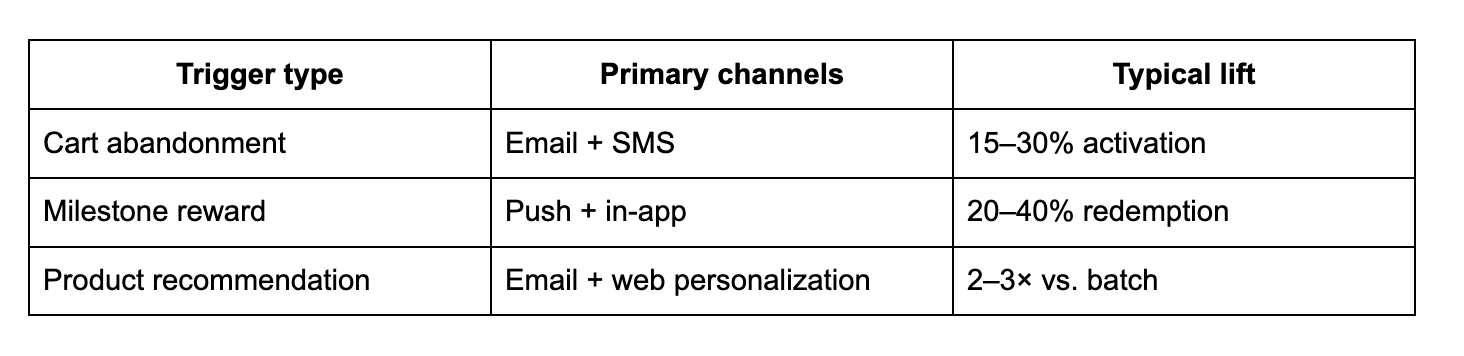
Unified and consistent experience for customers and real-time personalization across multiple channels consistently drive higher engagement and retention because they respond to customer intent in the present moment. When signals like cart abandonment, back-in-stock availability, or order completion trigger coordinated cross-channel outreach, marketers see materially higher activation.
Consider the following example. A Shopify order or cart event can trigger an email confirmation, a follow-up SMS reminder, a push notification, and in-app product recommendations. Zero-party data captured via web overlays (preferences, intent signals) can sync into a customer data platform (CDP) and flow into push notification services for tailored campaigns. These orchestrated journeys increase transaction frequency and downstream LTV, while reducing wasted impressions and CAC.
Equally important is frequency capping and digital channel prioritization. Orchestration layers that prefer push for app users, reserve SMS for high-value customers, and suppress redundant messages that reduce fatigue and unsubscribe risk. BCG research shows brands that balance personalization with channel discipline drive 10-20 percentage points of cross-sell, which directly improves retention.
High-impact triggers include:
- Cart abandonment: Email + SMS sequence with 15–30% activation lift vs. email only (Deloitte)
- Post-purchase: Email review request + push for loyalty rewards, driving 20–40% higher repeat purchase (BCG)
- Back-in-stock: Push for app users, email for web shoppers, with 2–3× higher conversion than batch (BCG)
Business Results From Omnichannel Integrations
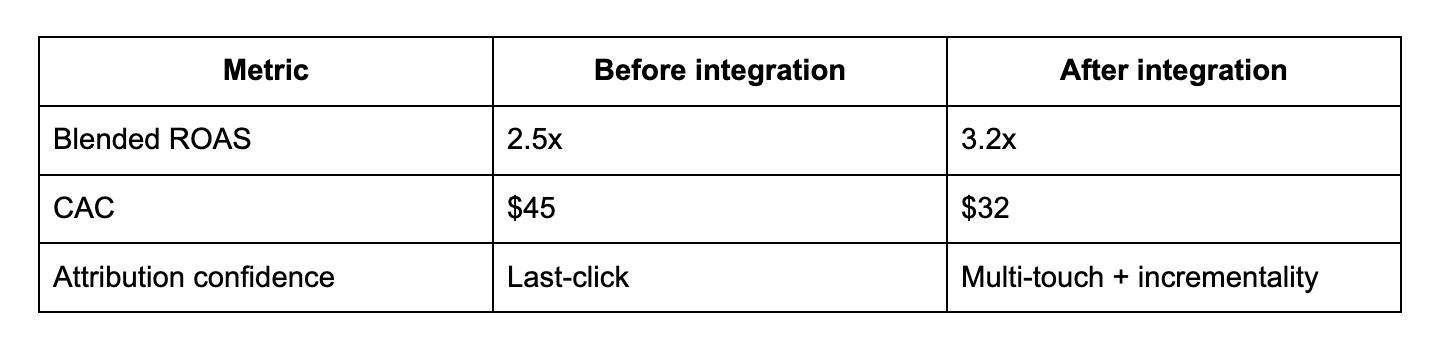
Closed-loop measurement is where omnichannel integration turns marketing into a financial lever. When conversion data from owned and paid channels flows into unified reporting and multichannel attribution, teams can run incrementality tests and holdout groups to isolate what actually drives lift.
KPIs omnichannel leaders track include:
- ROAS improvement: 10–20% lift from conversion APIs
- CAC reduction: 20–30% via owned-channel optimization (Deloitte)
- Attribution accuracy: 30–50% more conversions correctly attributed (BCG)
- Time-to-insight: Quarterly → weekly/daily optimization cycles
Core Components of B2C Omnichannel Integrations
Effective omnichannel integration rests on three technical pillars:
- Targeting and personalization powered by first- and zero-party data
- Integration architecture and interoperability that ensure reliable data flow
- Measurement and attribution that tie spend to revenue. Together, these components enable the business outcomes discussed above.
Targeting and Personalization in Omnichannel B2C
Targeting and personalization are where omnichannel integration delivers immediate, measurable value for B2C marketers, especially in regulated environments like financial services, where first-party and zero-party data are critical.
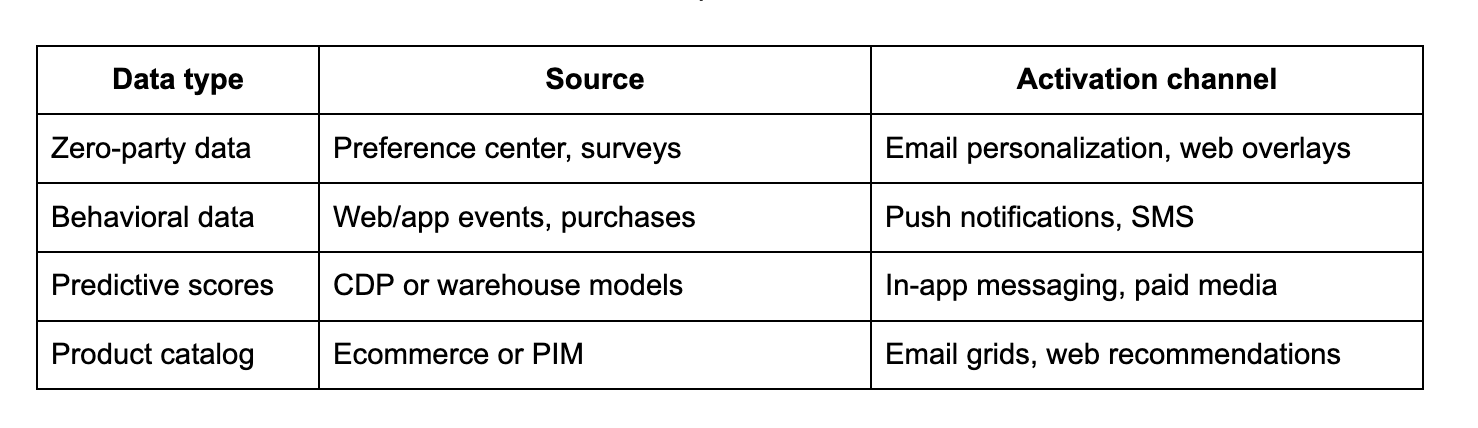
Zero-party data is information customers explicitly share, like their preferences collected via surveys, onboarding flows, or rewards preference categories. First-party data is behavioral data you observe directly: purchases, app sessions, web browsing, or offer redemptions. Together, these data types form the foundation of a compliant first-party data strategy in a post-cookie world.
When integrated across systems, these inputs power robust audience segmentation. Marketers can target customers based on recent behavior, demographics, or predictive signals like churn risk and lifetime value. McKinsey finds that companies excelling at personalization generate 10–15% higher conversion rates and materially improve retention by delivering relevance in the moment.
Omnichannel integrations ensure personalization is consistent everywhere. For example, a web overlay captures category preferences (zero-party data), syncs them to a CDP, and immediately fuels personalized email marketing, in-app banners, and push notifications powered by real-time product catalog feeds and recommendation engines.
Key segmentation dimensions to consider are:
- Behavioral: Recent purchase, cart abandonment, browsing history
- Demographic: Age, location, device type
- Lifecycle stage: New, repeat, at-risk
- Engagement level: App users, email-only, dormant
- Predictive: LTV score, churn risk, next-best product
Integration Architecture and Interoperability
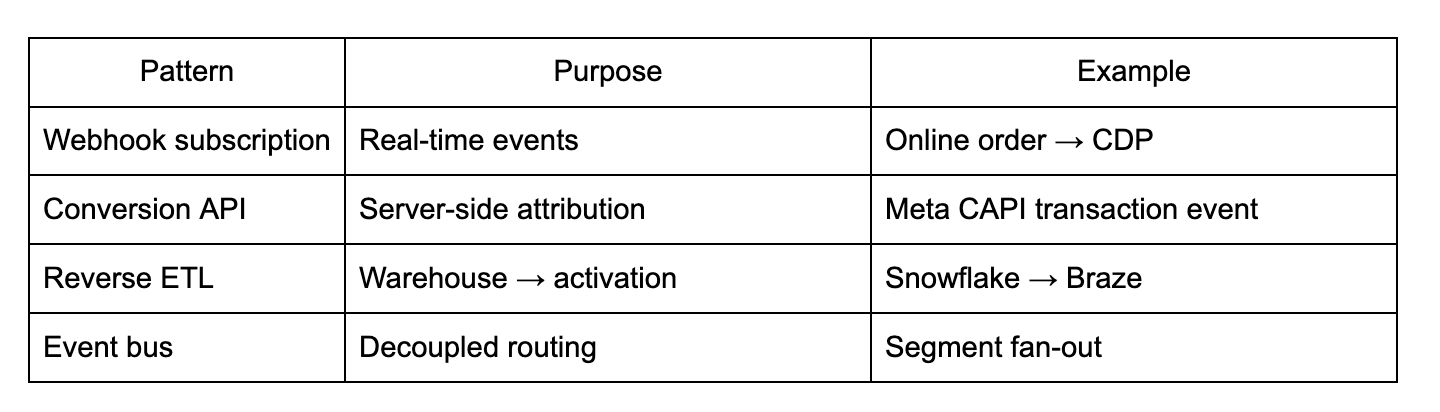
A resilient integration architecture is what makes omnichannel marketing trustworthy at scale. Modern B2C stacks rely on API-first architecture to move data reliably between systems. Webhook subscriptions enable real-time event delivery (e.g. online sales order or refund events), while event buses decouple producers from consumers so the same event can flow simultaneously to a CDP, ESP, analytics tools, and ad platforms.
Reliability patterns are what keep this architecture from breaking under real-world conditions. Consider a commerce platform webhook for a new order: the integration layer ingests the event idempotently (so duplicates don’t inflate revenue), routes it to the CDP, ESP, and BI tools, and logs each step. If the ESP API is temporarily unavailable, retry logic with exponential backoff kicks in.
At this point, persistent failures are routed to an error or dead letter queue and flagged via monitoring alerts. The same server-side principles power conversion APIs like Meta CAPI and Google Enhanced Conversions, which send verified transaction data directly to ad platforms, improving attribution accuracy and optimization compared to client-side pixels.
Integration reliability best practices:
- Idempotent event ingestion to prevent double-counting
- Retry logic with exponential backoff (1s, 2s, 4s, 8s)
- Error queues / dead letter queues for failed events
- Monitoring and alerting for uptime, latency, and error rates
- API rate-limit handling with queuing
Without a scalable, observable integration layer, omnichannel analytics and orchestration can’t be trusted. This makes reliable architecture the foundation for confident spend, attribution, and personalization.
Measurement and Attribution Across Channels
Effective measurement and attribution across channels is the feedback loop that makes omnichannel integration financially defensible.
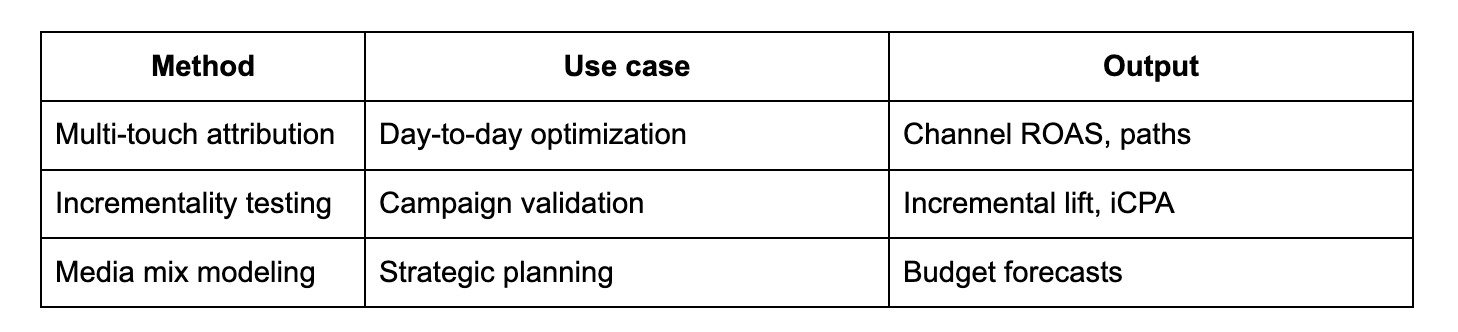
A modern attribution stack combines multi-touch attribution (MTA) for day-to-day optimization, incrementality testing with holdout groups to measure true causal lift, media mix modeling (MMM) for strategic budget allocation, and BI dashboards that unify outputs into a single source of truth. Used together, these approaches balance speed and rigor, optimizing campaigns in-flight while informing longer-term spend decisions across brand and performance channels.
Accuracy improves when measurement is closed loop. Matching ad exposures or message sends to verified transactions (via ecommerce APIs or card-linked offer matching) reduces over-attribution and data loss. Google Ads Enhanced Conversions and Meta’s Conversion API send hashed, server-side transaction data back to ad platforms, improving signal quality and attribution in privacy-first environments. Platforms report that these methods outperform client-side pixels, enabling more reliable ROAS and CPA tracking.
Recommended testing progression:
- A/B testing: Optimize creative and targeting within a single channel
- Multi-touch attribution: Allocate credit across touchpoints for channel mix optimization
- Holdout groups: Measure true incremental lift beyond last-touch
- Media mix modeling: Guide strategic, long-term budget allocation
3 High-ROI Omnichannel Use Cases for B2C Marketing Tech
Omnichannel integrations deliver measurable impact by connecting trigger events, customer data, and coordinated channels across the customer lifecycle.
For financial institutions, fintechs, neobanks, and traditional banks, these integrations turn real-time POS and ecommerce transaction data into actionable campaigns that improve activation, revenue, and retention while reducing wasted spend. Below are three high-ROI use cases that illustrate how cross-channel orchestration drives results.
1. Welcome Series for New Customers
- Trigger: Account creation
- Channels: Email + SMS + push notifications
- Data dependencies: CDP segmentation, first-party account and behavioral data
- Key metrics: 40-60% activation rate, reduced time-to-first-purchase
Description: A coordinated welcome series introduces new customers to relevant banking products or offers. For example, an SMS reminder 24 hours after sign-up paired with a push notification in the app increases early engagement and reduces drop-off. Real-time data from account creation events ensures the message sequence is triggered immediately, maximizing activation potential.
2. Cart Abandonment Recovery
- Trigger: Cart abandonment event from Shopify or ecommerce platform
- Channels: Email (1 hour later) + SMS (4 hours later) + web retargeting
- Data dependencies: Real-time order webhooks, CDP audience segmentation, product catalog feeds
- Key metrics: 15-30% recovery rate, incremental revenue per recovered cart
Description: Coordinated follow-ups across email, SMS, and web retargeting recover lost sales. POS and ecommerce data feed paid media retargeting audiences, suppressing recent purchasers, and dynamically showing products left in the cart. Real-time triggers ensure timing aligns with purchase intent, outperforming batch campaigns.
3. Cash Back Offers
- Trigger: Customer opens their banking app
- Channels: Push notifications + email + in-app banners
- Data dependencies: Rewards demand platform (like Kard), CDP audience segmentation, conversion API feedback loops
- Key metrics: 25-40% redemption rate, 20-35% engagement lift (see case studies here)
Description: Cash back rewards are promoted across channels with personalized messaging. By syncing redemption events to the CDP and back to paid media platforms, marketers can suppress already-rewarded customers from additional spend while targeting high-value, under-engaged users. This drives measurable lift in engagement and repeat purchases.
Cross-channel coordination and real-time data orchestration accelerate activation, recover lost revenue, and increase engagement. Financial marketers who implement omnichannel integrations see ROI in weeks rather than months, improve customer lifetime value, and reduce wasted ad spend through smarter audience targeting and suppression.
Overcoming Common Omnichannel Integration Challenges
Implementing omnichannel integrations can transform B2C marketing performance, but martech teams often face technical and operational obstacles. Below are four common challenges with practical solutions and business outcomes you should aim for.
Data Quality and Consistency
Challenge: Inconsistent event schemas, duplicate records, and missing data fields undermine personalization and attribution.
Solution: Implement a centralized event taxonomy, enforce schema validation, apply deduplication rules, and monitor data quality through dashboards.
Business Outcome: Reliable, high-quality data improves segmentation accuracy, enhances real-time personalization, and reduces campaign errors, thereby supporting higher conversion rates and better ROI.
Identity Resolution Across Devices and Channels
Challenge: Difficulty stitching web, app, email, and offline interactions into unified customer profiles.
Solution: Use deterministic matching (email, user ID) as the primary method, supplement with probabilistic matching (device graphs) for anonymous sessions, and implement identity graphs within a CDP.
Business Outcome: Unified customer profiles enable coordinated cross-channel messaging, increasing activation rates, and improving LTV through consistent personalization.
Consent and Privacy Compliance
Challenge: Capturing, storing, and enforcing GDPR/CCPA consent across all activation channels.
Solution: Deploy a centralized consent management platform, sync consent states via API to downstream tools, and provide a preference center for customer control.
Business Outcome: Compliance reduces legal risk, builds customer trust, and increases opt-in rates. Customers who opt in to personalization convert more frequently.
Integration Complexity and Maintenance
Challenge: Managing dozens of API connections, monitoring uptime, and handling schema changes.
Solution: Use integration platforms like Segment or Fivetran with prebuilt connectors, implement monitoring and alerting, and maintain thorough API documentation.
Business Outcome: Reduced downtime and faster issue resolution improve system reliability, ensuring campaigns run smoothly and minimizing lost revenue from failed triggers.
By addressing these challenges, marketing teams can trust their data, orchestrate seamless cross-channel campaigns, and achieve gains in engagement, activation, and ROI.
Best practices for B2C omnichannel integrations
Successfully implementing omnichannel integrations requires a structured, phased approach that balances strategy, execution, and optimization. Follow the best practices below to ensure your omnichannel integration runs smoothly.
Phase 1: Strategic Planning
Begin by aligning stakeholders across marketing, engineering, analytics, and legal on objectives and success metrics such as ROAS, CAC, and multi-touch attribution accuracy.
Audit your existing stack to identify gaps, design the target integration architecture, and prioritize high-impact use cases like cart abandonment recovery or post-purchase cross-sell. Assign marketing operations to lead use case selection, engineering to map system dependencies, and analytics to define KPI baselines.
Phase 2: Tactical Execution
Establish a robust identity foundation with deterministic and probabilistic matching to unify profiles. Integrate core channels (email, SMS, push, web) with the CDP, and implement centralized data governance including UTM/campaign naming conventions, deliverability monitoring, and feed synchronization.
Build observability dashboards to track pipeline uptime, event latency, and identity match rates. Launch 1–2 pilot use cases with coordinated channel orchestration to validate flows. Owners: engineering (integration), marketing ops (campaign activation), analytics (monitoring).
Phase 3: Performance Optimization
Leverage unified reporting to analyze conversion paths, ROAS, and channel performance. Run A/B tests and incrementality studies to refine targeting and channel mix. Expand successful pilots gradually, iterating based on attribution insights. Governance best practices ensure consistency and speed.
KPIs to track from day one include campaign activation time, identity match rate, event delivery latency, channel-level ROAS, and multi-touch attribution accuracy.
Advantages of B2C omnichannel integrations
Omnichannel integration offers many benefits as outlined above. To reap these benefits, you’ll want to make sure you integrate customer journey touchpoints in a streamlined way. Luckily, Kard’s API-first platform helps facilitate the creation of these touchpoints and measures their impact.
You also want to keep in mind that not all customers purchase with the same mindset, especially today’s younger customers, many of whom will delay purchasing items they need or want until they come across a discount. You need to make sure you offer deals at the right time and based on past purchase behavior. Keep in mind that they also want to receive personalized marketing notifications.
So customers want to save by purchasing at places and moments with deals available. But what do you do when so many businesses constantly offer deals? How do you reel in consumers when your very own competitors offer deals that you also plan on offering?
Think as outside the box as possible with your omnichannel marketing efforts. Why should customers reach for your products in a market filled with similar products and services? How will you stand out in this sea of sameness?
Omnichannel integration and uniqueness can help you convert consumers into your customers. This integration can also create a cohesive customer experience.
FAQs About Omnichannel Integrations for B2C
How do omnichannel B2C integrations differ from multichannel integrations?
Multichannel marketing runs multiple channels (email, SMS, social, paid ads) in parallel, often with siloed data and separate campaigns, leading to duplicated effort, inconsistent messaging, and poor cross-channel attribution.
Omnichannel marketing strategies, by contrast, synchronize customer data, identity, and decisioning across all channels, which enable centralized orchestration, managed frequency, and measurement of the full customer journey. Having an omnichannel marketing automation platform helps drive better performance and efficiency.
How long do omnichannel integrations typically take?
Omnichannel integrations for B2C marketing tech can vary widely in implementation time depending on scope and complexity. MVP setups using prebuilt connectors, like Segment to Braze or Shopify to a CDP, typically launch initial use cases in 2–4 weeks.
Establishing a robust foundation, including custom API integrations, identity resolution models, and data warehouse configuration, usually takes 8–12 weeks. A full-stack rollout with all channels, advanced attribution, and optimization frameworks can extend to 6–12 months.
How is privacy handled in omnichannel B2C integrations?
Integrations require rigorous privacy compliance to meet GDPR, CCPA, and other regulations. A best-practice consent flow begins with capture via web forms, app checkboxes, or preference centers, followed by storage in a centralized consent management platform (CMP) or CDP with audit logs.
Propagation ensures all downstream tools (ESP, push, SMS, and ad platforms) receive up-to-date consent states via API sync. Finally, enforcement occurs in real time, blocking messages or targeting where consent is not granted. For EU ad tech, TCF strings may also be used to standardize consent signaling.