You ran a Reels campaign, a cash back offer, and an email blast and revenue went up. Who gets credit?
We all know that's a trick question. And yet — the answer drives budget allocation, team incentives, and every ROI conversation with your CFO. Get it wrong and you're not only funding the wrong channels, you're messing with people's money.
Attribution has been marketers' solution to this challenge for decades, but even the platforms are still refining it. Meta just overhauled its measurement framework in early March 2026, narrowing click-through attribution to link clicks only (dropping likes, saves, and shares from that bucket) to better align with how third-party tools like Google Analytics count conversions.
The update is a useful reminder that attribution definitions aren’t fixed. They shift as platform behavior and measurement standards evolve.
Which is exactly why merchants need to understand the underlying models rather than just trusting dashboard defaults. Here's how to think carefully through your marketing attribution model, your marketing measurement strategy, and modify it over time.
What Is Marketing Attribution?
Marketing attribution is the practice of assigning credit to the marketing touchpoints that influence a customer's decision to buy. It answers the question: which channels, campaigns, or interactions actually drove this conversion?
In a single-channel world, attribution is trivial. A customer clicks a Google ad and buys: obviously, the attribution goes to the ad.
But today's retail and QSR customers might encounter your brand through a social post, a loyalty email, a cash back offer in their banking app, and a geo-targeted push notification before they ever walk through your door. Each of those touchpoints played some kind of role in getting them to purchase.
Marketing attribution models are the frameworks that determine how much credit each one gets.
And getting attribution right matters more than it ever has. Customer acquisition costs have risen 25-40% by channel as of Q1 2025. When budgets are under pressure, misattributing spend (aka over-crediting one channel while starving another) directly accelerates that cost problem.
Why Marketing Attribution Is Hard for Retail & QSR
Most attribution systems were built for search-era behavior: a customer clicks an ad, lands on a page, converts. But, as we've alluded to, retail and QSR don’t work that way.
According to MoEngage, 45.7% of QSR brands cite channel effectiveness clarity as a top engagement challenge, and 36.2% name attribution as a core business objective.
Here’s what makes it hard:
- Offline conversions. A customer who sees a paid social ad and buys in-store three days later is invisible to most digital attribution tools.
- Short purchase cycles. A QSR customer might go from first awareness to drive-thru in 20 minutes, collapsing the “journey” into something attribution windows can barely capture.
- Channel fragmentation. According to McKinsey, 53% of advertisers used five or more Commerce Media Networks in 2024, up from 38% the year prior. More partners means more conflicting dashboards, each using different attribution windows and definitions.
- Retail media inconsistency. One vendor might attribute a sale to a click within a 14-day window while another uses 7 days. There’s really no industry standard.
Understanding these challenges is the prerequisite for choosing the right attribution model (or rather, the right combination of them).
Single-Touch Marketing Attribution Models
Single-touch models assign 100% of credit to one interaction. They're easy to implement and interpret, but they ignore everything else that happened in the customer journey.
First-Touch Attribution
Best for: New market launches, brand awareness campaigns, understanding which channels introduce net-new customers.
First-touch credits whatever channel first introduced the customer to your brand: a TikTok ad, a search result, a word-of-mouth referral.
Pros
- Clean signal for awareness measurement.
- Shows which channels are filling the top of your funnel and generating new customer introductions.
- Easy to implement in any analytics platform.
Cons
- Gives zero credit to every subsequent interaction, including the ones that actually drove the purchase.
- If a customer discovered you via Instagram but converted six weeks later after receiving a cash back offer, first-touch credits Instagram for the whole thing.
Last-Touch Attribution
Best for: Direct response campaigns, short purchase cycles, daily tactical optimization.
Last-touch credits the final touchpoint before conversion, the channel that “closed” the customer.
Pros
- Strong signal for bottom-funnel optimization.
- It’s also the default model for most ad platforms (Google Ads, Meta Ads Manager), making it easy to benchmark against platform-reported numbers.
Cons
- Systematically over-credits retargeting, promotional offers, and branded search — channels that often intercept customers who were already going to convert. Awareness and consideration channels get nothing.
Last Non-Direct Attribution
Best for: Brands with high direct traffic volumes where last-touch consistently over-credits "direct" as a channel.
A variation of last-touch that excludes direct traffic (customers who typed your URL directly). Gives credit to the last non-direct channel a customer used before converting. This is useful when direct traffic is masking the actual source of conversion intent.
Here’s how the same journey can tell two different stories:

A concrete QSR example: A fast-casual chain runs paid social alongside a Kard cash back offer distributed through a banking app. A customer sees the Instagram ad, sits on it, converts two weeks later after receiving the cash back push. First-touch credits Instagram, last-touch credits the offer (both could’ve had some influence).
Multi-Touch Marketing Attribution Models
Multi-touch models distribute credit across multiple touchpoints based on predefined rules. More accurate than single-touch, but still rule-based. The weights are assumptions built into the methodology, not derived from your actual conversion data.
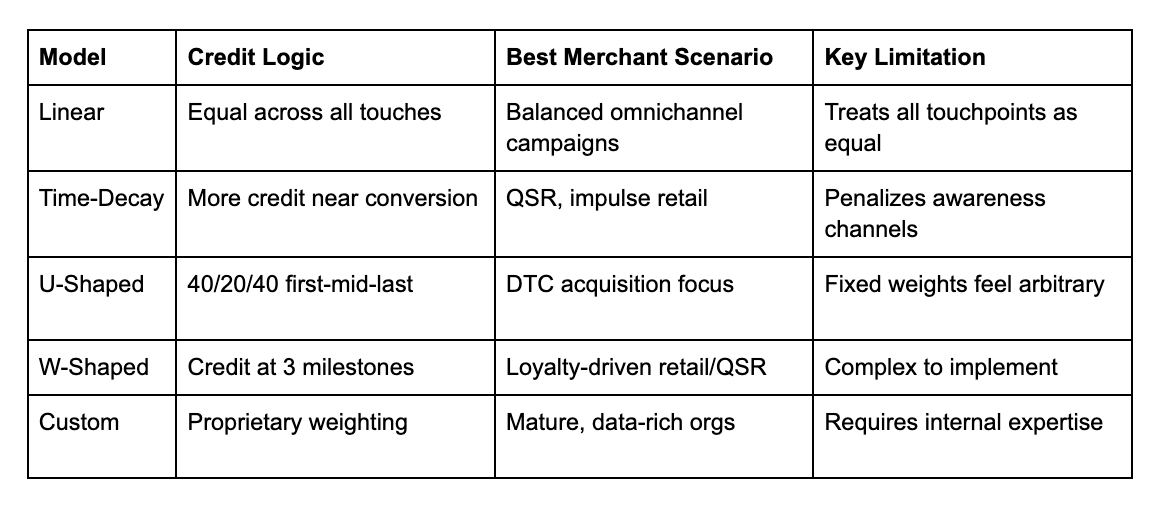
Linear Attribution
Best for: Organizations that want to acknowledge all channels without over-engineering the weighting logic.
Distributes credit equally across every touchpoint in the customer journey. If a customer hit five channels before converting, each gets 20%.
Pros
- Promotes cross-channel collaboration and prevents teams from fighting over credit.
- Easy to explain to non-technical stakeholders.
Cons
- Treats a brand awareness impression the same as a high-intent click the day before purchase.
- Rarely reflects how customer journeys actually work.
Time-Decay Attribution
Best for: QSR and impulse-buy retail where decision cycles are short and recency is a legitimate conversion signal.
Gives more credit to touchpoints closer to the conversion event. The push notification that fired three hours before a QSR order gets significantly more weight than the Instagram ad from three weeks ago.
Pros
- Intuitive and defensible for short purchase cycles.
- Reflects the reality that recency often predicts conversion intent.
Cons
- Can starve upper-funnel channels that genuinely contribute to awareness and consideration, especially in longer purchase cycles.
U-Shaped (Position-Based) Attribution
Best for: DTC retail brands focused on both new customer acquisition and conversion optimization.
Concentrates credit on two pivotal moments: first touch (40%) and last touch (40%), and splits the remaining 20% across middle interactions.
Pros
- Honors both acquisition and conversion.
- Better than linear at reflecting the relative importance of different journey stages.
Cons
- The 40/20/40 split is an assumption, not derived from data.
W-Shaped Attribution
Best for: Retail or QSR brands with loyalty programs where signup is a high-value event independent of the first transaction.
Adds a third credit emphasis point, typically a mid-funnel milestone like a loyalty program signup, app download, or first cart add. Credit concentrates at first touch, the milestone moment, and final conversion.
Pros
- Acknowledges that some mid-funnel actions are themselves meaningful conversions.
Cons
- More complex to configure.
- Requires clearly defining what constitutes a “milestone” in your customer journey.
Custom Attribution
Some organizations build their own weighting logic based on internal data, business rules, or known channel performance. Custom models can incorporate offline behavior, loyalty status, or channel-specific conversion rates.
Best for: Mature marketing organizations with strong data infrastructure and a clear hypothesis about which touchpoints matter most.
The Retail Media Attribution Problem (and the Commerce Media Alternative)
U.S. advertisers will spend $69.33 billion on retail media in 2026, up from $58.79 billion in 2025. But the attribution environment is a mess. Forrester’s 2024 Retail Media Networks report lists multi-touch attribution as still an “extended use case” for RMN advertisers, meaning even sophisticated retailers are still trying to move past single-touch measurement within their own ecosystems.
There doesn’t seem to be a fix coming from the RMN side. The answer is building your own internal source of truth using first-party data that doesn’t depend on any platform’s self-reporting.
Commerce media can offer a structural advantage here. At its core, commerce media connects advertising to verified purchasing behavior: actual card transactions, not inferred clicks.
Take Kard, for example, the first independent commerce media network. Kard uses predictive AI and first-party transaction data from tens of millions of cardholders (~$70B in annual volume) to power hyperpersonalized cash back offers for retail and QSR brands. When a consumer redeems a Kard offer, that purchase is tracked and attributed directly back to the reward, whether online or in-store.
Kard’s Gen Z and Millennial reach is particularly strong — the demographic marketers consistently identify as hardest to reach. And the pay-for-performance model means brands only pay when purchases actually happen.
Data-Driven & Advanced Attribution Models
For merchants with the data volume and infrastructure to support it, algorithmic models replace fixed rules with statistical analysis of actual conversion patterns.
Shapley Value Attribution
Borrowed from game theory, Shapley value calculates each channel's marginal contribution by analyzing every possible combination of touchpoints. A channel earns credit proportional to how much worse performance would be without it.
Pros
- Methodologically sound.
- Doesn’t rely on arbitrary weighting decisions.
Cons
- Computationally intensive.
- Requires large conversion volumes to produce stable results.
Markov Chain Attribution
Maps the customer journey as a probability graph. Each touchpoint is a node and edges represent the likelihood of moving from one state to another. Identifies “removal effects,” the conversion drop if you eliminate a specific channel entirely.
Pros
- Directly supports budget reallocation decisions.
- Shows channel interdependencies, not just individual performance.
Cons
- Requires significant data infrastructure and technical expertise to implement correctly.
Machine Learning Attribution
ML models, including LSTM neural networks with attention mechanisms, learn patterns from raw journey sequences at scale. They can integrate cross-device behavior, real-time signals, and offline conversion data.
Pros
- Highest potential accuracy.
- Adapts as customer behavior changes.
Cons
- Substantial data and compute requirements.
- Most mid-market merchants don't have the infrastructure in-house.

For most retail and QSR merchants, a hybrid measurement stack delivers better practical results than chasing a single advanced model.
The Hybrid Attribution Stack in Practice
No single model covers everything, and the merchants with the most reliable measurement combine approaches by use case. For example:

As Tonya Walker, Fractional CMO, wrote for Martech: “Attribution can inform decisions, but leadership makes them.” The model is the tool, but someone still has to decide how to interpret and use the results.
How to Choose the Right Marketing Attribution Model
Step 1: Define the business question first
Before picking a model, define what decision it needs to support.
New customer acquisition? Channel budget reallocation? Proving ROI to a CFO? The question determines the model, not the other way around.
Step 2: Match model to sales cycle
Here’s a helpful guide:

Step 3: Build up, not sideways
Start with last-touch, because it’s already what most platforms report. Setup is minimal and benchmarking is easy.
Once conversion tracking is clean across channels, layer in multi-touch for strategic planning. Then add incrementality testing once you need to prove causation.
Step 4: Add incrementality testing
This is the most skipped step and the most important one.
Every model covered above shows correlation: which channels were present when conversions happened. None of them actually prove those channels caused the conversion.
Incrementality testing does. By holding out a control group that doesn’t see a campaign, you measure whether the campaign drove behavior that wouldn't have happened anyway.
Would that shopper have bought without the cash back offer? Incrementality answers that.
Did you know? Kard builds incrementality testing into its standard measurement methodology. With tens of millions of cardholders in its network, Kard has the statistical power to construct valid holdout groups and measure true causal lift. That's the difference between proving ROI and asserting it.
Step 5: Reconcile platform data with internal transaction records
Most platforms define first-touch and last-touch differently and apply different lookback windows. When a platform reports 1,000 conversions and your transaction records show 600, the discrepancy is almost always attribution window differences or double-counting. Your internal data doesn't have that problem. Transaction-level card data is the reconciliation layer no platform can override.
Four common pitfalls to watch out for
- Switching attribution models mid-campaign and comparing results as if they’re equivalent
- Treating any platform’s dashboard as ground truth
- Ignoring offline conversions because they're harder to measure
- Running incrementality testing once and calling it done
What to Remember About Marketing Attribution Models Now
If you remember anything from this article, it should be these three things:
- Define the business question before picking the model
- Run last-touch for speed, multi-touch for strategy, incrementality for proof
- First-party transaction data is your most defensible measurement foundation, especially as cookie deprecation continues and RMN attribution windows stay fragmented
Kard brings verified transaction data from tens of millions of cardholders, hyperpersonalized cash back offers in authenticated banking environments, and closed-loop attribution across online and in-store purchases — with incrementality methodology that proves conversions are genuine.
Want to learn more about cash back offers and how you can track them? Get in touch with our team.
FAQs About Marketing Attribution Models
Which marketing attribution model should a retail merchant start with?
Last-touch. It’s already what most ad platforms report, so setup is minimal. It definitely won;t show the full picture, but it establishes a solid baseline. Once conversion tracking is consistent across channels, consider layering in a U-shaped or W-shaped model to surface how upper-funnel channels are contributing. The goal is to build marketing attribution model maturity over time, not finding a perfect model from day one.
How do we know if our attribution model is actually working?
Change your spend and see if results move proportionally. If your model credits Instagram with say, 40% of conversions, but cutting your Instagram budget by half doesn’t affect revenue, you’re probably just measuring correlation. Incrementality testing is the only real answer: holdout experiments that measure whether campaigns drove behavior that wouldn’ have occurred otherwise.
What’s the difference between marketing attribution and marketing mix modeling (MMM)?
Attribution operates at the individual customer journey level, tracking which touchpoints a specific person encountered before converting. MMM operates at the aggregate level, using statistical modeling to estimate the contribution of each channel to overall revenue over time, including offline channels and external factors like seasonality. Both are useful, but answer different questions. Attribution informs tactical optimization whereas MMM informs long-term budget strategy.