.png)
For most issuers, standing up a rewards experience is a months-long project. The backend work is manageable, but the frontend — things like offer discovery, search, maps, responsive layouts — turns one sprint into another, and another, then another.
A month ago, we released WebView, a Kard-hosted rewards frontend experience that cuts out that entire process.
You embed it directly into your app, getting you from zero to a production-ready rewards experience.
Atlas, one of our long-standing distribution partners, already has it running in production.
As Yudai Yaguchi, software engineer at Atlas puts it:
“We’d been on Kard’s API integration for years, and it served us well. But every new offer type meant another item on our engineering backlog. With WebView, we were live in two weeks, and with our cardholders getting every new Kard enhancement automatically, our team has more time to focus on high-pri product features.”
Keep reading to learn more about what WebView is, what implementation looks like, and the benefits it’s brought to Atlas so far.
What is WebView?
WebView is a pre-built, ready-to-deploy rewards experience that can be embedded directly into your banking app with minimal development work.
Think of it as an “in-app browser” that we’ve already coded and optimized for cardholder engagement. Your team doesn’t have to spend time designing or building the interface.
Why use WebView?
The reason our customers are gravitating toward WebView is that building a memorable, intuitive, engaging rewards experience is hard.
Figuring out what offers cardholders see, how they search for offers, how promoted rewards show up (especially on different devices) — all of that requires thoughtful design. And every new offer type or rewards feature we release has to be added in just as thoughtfully.
Not every distribution partner has the resources or bandwidth to support this work. With WebView, they don’t have to. It’s a rewards interface out of the box, complete with:
- A browseable offer feed
- Search
- Category filtering
- Nearby offers
- A map view
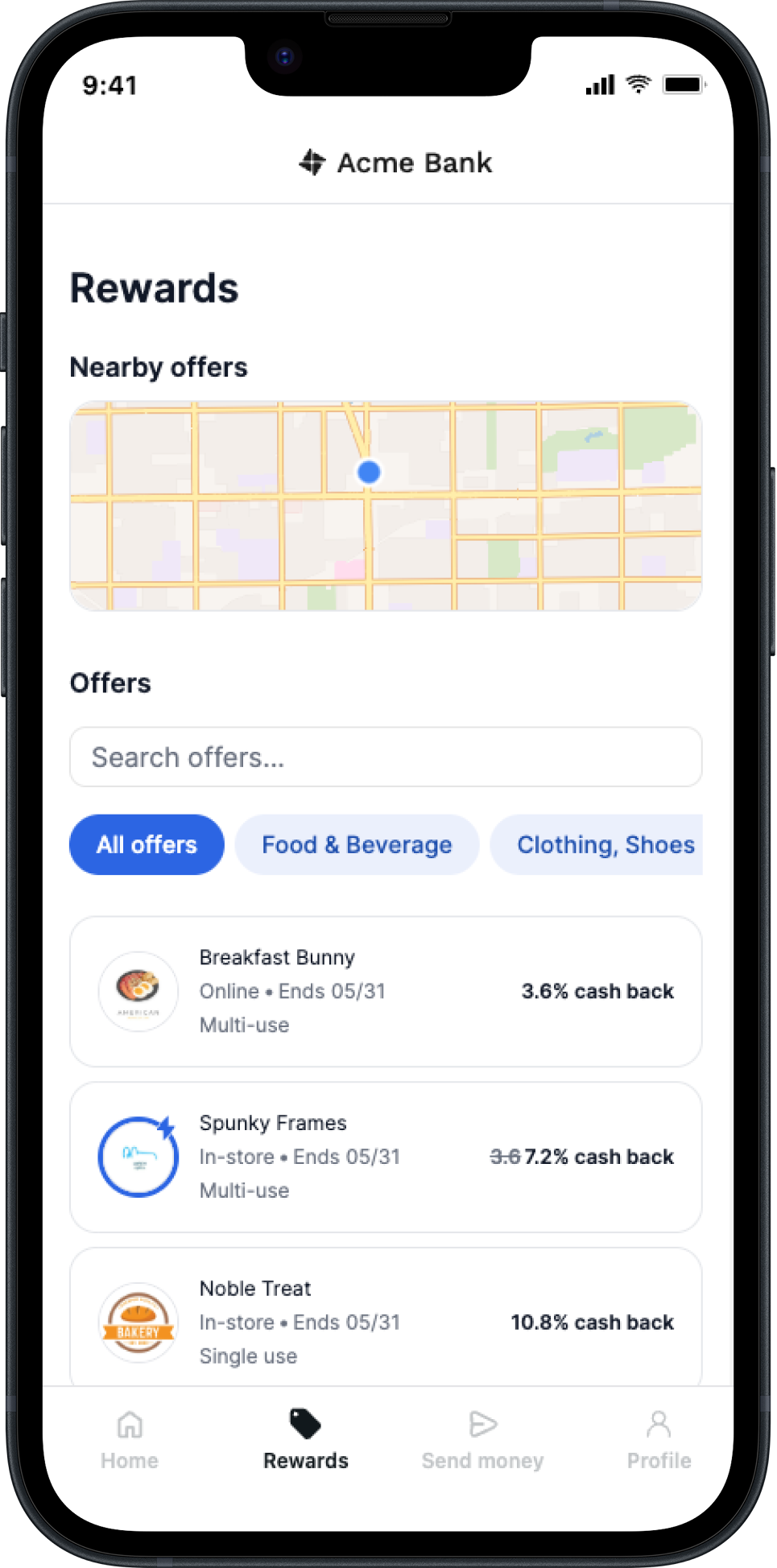
WebView is designed to feel quick and natural, adapting to whatever device a cardholder is using. It works in native iOS, Android, and React Native apps through respective WebView components, and on web apps via iframe.
The most relevant offers surface first, with the cash back reward amount or percentage displayed prominently. Users can also filter by offer category or explore a map view to see what local offers are available nearby.
What switching to WebView involved
When you’ve already invested in a custom integration, moving to something new can feel risky.
Atlas wanted to be sure that the new version of the platform could truly match what their team built. And they definitely didn’t want to disrupt the cardholder experience.
But the transition to WebView only took two steps. Since Atlas had already wired up its backend to Kard’s rewards API, and configured its specific program mechanics, all the team had to do was:
- Customize the UI to fit Atlas’s copy, messaging, colors, fonts, and layouts.
- Embed WebView into the Atlas app with a small code snippet.
On the auth side, they generated a JWT to identify Atlas as the issuer and the specific cardholder, then passed it to WebView to confirm each session.
Note: We have SDKs that handle token generation if you don’t want to handle that yourself.
For maps and nearby offers, WebView requests location via a simple message-passing contract. Atlas’s app passes the coordinates, and WebView takes it from there — no rendering logic or layout system to wrangle.
Two weeks of work, from beginning to end.
The results they’ve seen
Normally, standing up a new UI takes months. The fact Atlas pulled off a new integration in just two weeks says a lot about how much heavy lifting WebView takes off an engineering team.
Plus, now a substantial group of Atlas cardholders has access to dynamic offers, a new set of cash back rewards that respond to customer behavior, like repeat purchases, spending progress, or engagement.
These offers are specifically designed to incentivize more purchases, make cards stickier, and yield greater customer LTV, so getting those in front of more cardholders means:
- More activity in the program
- Stronger brand association
- A better shot at pushing Atlas to top of wallet
All without Atlas having to design and build any of it themselves.
Want your rewards experience live next month?
If you’re hoping to launch your rewards quickly and offload frontend maintenance for good, WebView was built for you.
- Check out our WebView demo
- Explore our docs
- Reach out to the Kard team to talk through options specific to your stack
Did you know we’ve got three ways to integrate Kard? Explore them all here.


.png)