Three teams take credit for the same sale. The paid search team points to the last click, social claims the carousel ad from three days prior, and demand gen mentions the cash back offer that they feel actually pushed the customer over the line.
This is what broken attribution looks like, and it’s draining budgets (and employees) everywhere.
Why? Because it’s really, really hard to do attribution right.
According to Salesforce’s State of Marketing Report, only 26% of marketers are completely satisfied with how they’re unifying data. And it’s prohibiting them from:
- Creating hyper-relevant experiences
- Tracking their ROI
- Experimenting with different channels
- Spending money on the campaigns that truly make a difference
Multi-touch attribution is part of the fix. By assigning partial credit across the entire customer journey, not just the touchpoint that happened to be first or last, marketers get a better picture of their campaign performance and how it should evolve over time.
Below is everything brand marketers need to know to build it right.
Why Multi-Touch Attribution Is a Non-Negotiable for Modern Merchants
Pretty much any brand marketer — whether they’re working for a retail, QSR, grocery, or subscription brand — are running a whole lot more than one channel. They’re running 5+, each with different teams, reporting tools, and definitions of success. None of which talk to each other particularly well.
That fragmentation has a big cost. When each team measures itself in isolation, every channel can look like it’s winning, even when it’s not.
Multi-touch attribution is what ties those siloed signals into a single, coherent view of how customers actually move toward a purchase. And having that unified view is the only way you’re going to figure out where to put more of your budget.
For merchants running paid media, loyalty programs, email, and card-linked offers simultaneously, multi-touch attribution is the connective tissue that keeps channel decisions from cannibalizing each other.
The Six Main Multi-Touch Attribution Models
No model is universally correct. Each one reflects a different belief about how customers decide to buy. The right model for you depends on your customer journey complexity, channel mix, and data maturity.
Last-click
100% of credit goes to the final touchpoint before conversion. Simple to implement, easy to explain to a CFO.
The problem: it treats everything that happened before the final click as irrelevant, which systematically undervalues upper-funnel channels like brand awareness, email, and loyalty offers.
Best for: direct response campaigns with a single-step purchase path.
First-click
100% of credit to the first touchpoint. Useful if you're trying to measure which channels introduce new customers to your brand.
The problem: Just as misleading as last-click for anything with a multi-step journey.
Best for: measuring acquisition channel efficiency in isolation.
Linear
Equal credit to every touchpoint, which is more honest than single-touch models.
The problem: It treats a banner impression from three weeks ago the same as the offer redemption the day before purchase. That rarely reflects how customers actually decide.
Best for: long consideration cycles where no single touchpoint dominates.
Time-decay
More credit to touchpoints closer to conversion. Weights recent interactions more heavily under the assumption that they were more influential in the final decision.
The problem: Tends to undervalue awareness channels that set up the purchase.
Best for: short sales cycles, flash sales, limited-time promotions.
Position-based (U-shaped)
40% to the first touch, 40% to the last touch, 20% split across everything in between. A reasonable compromise for brands that care about both acquisition and conversion efficiency.
Best for: omnichannel retailers tracking from discovery through in-store close.
Data-driven (algorithmic)
Machine learning analyzes your actual conversion data to determine which touchpoints are doing the most work. Credit is assigned based on real patterns, not a fixed formula. This is the most accurate model when it has enough data to learn from.
Best for: enterprise brands with high transaction volume, diverse channel mix, and clean data infrastructure.
Which Model Fits Your Situation?
Here’s what model typically works best for each of these scenarios:

One consistent mistake: brands with three months of conversion data trying to run algorithmic attribution. There's not enough signal. A position-based model built on clean data will outperform a poorly trained ML model every time.
A Multi-Touch Attribution Model Framework for Every Merchant Scenario
At the simplest end are single-touch models. First-touch gives full credit to whatever channel introduced the customer to your brand. Last-touch gives it all to whatever closed the deal. Both are easy to implement and easy to explain to a CFO — and both will systematically mislead you if your customers take more than one step before buying, which most of them do.
Multi-touch models distribute credit across the journey. Linear splits it equally across every touchpoint. Time-decay weights interactions closer to conversion more heavily. Position-based (sometimes called U-shaped) gives 40% to the first touch, 40% to the last, and spreads the remaining 20% across everything in between — a reasonable middle ground for brands that care about both acquisition and conversion, not just one.
Then there's algorithmic attribution. Instead of applying a fixed formula, machine learning analyzes your actual conversion data to figure out which touchpoints are doing the bulk of the conversion work, and weights them accordingly.
One ecommerce brand used a predictive AI model to optimize across paid search, social, and outreach timing, applying the outputs to decisions about coupons, promotions, and loyalty points. They cut media budget-planning time by 66% and grew brand awareness by 11%.

The model that's right for you depends on how complex your customer journey is and how much data you have to work with. A brand running three channels with six months of conversion data shouldn't try to build an algorithmic model — there's just not enough data there.
A national retailer with millions of transactions and a dozen active channels probably shouldn't be running last-touch. They'd be excluding too many variables.
Why Traditional MTA Is Breaking
Multi-touch attribution was built on a specific assumption: that you can track users across channels and devices via persistent identifiers, primarily third-party cookies. But that assumption no longer holds.
Cookie deprecation. Safari and Firefox blocked third-party cookies years ago. Chrome's deprecation efforts, while delayed, are ongoing. Any attribution infrastructure built on cookie-based tracking has a shelf life.
iOS ATT (App Tracking Transparency). Opt-in rates vary widely by app category, measurement methodology, and when in the onboarding flow the prompt appears a meaningful share of iOS users never see or respond to the prompt at all. For brands running mobile-heavy campaigns, the user-level data gap is real regardless of which benchmark you use.
GA4 consent mode gaps are a more immediate problem for most marketing teams. When users decline consent, GA4 fills in gaps with modeled data. The modeling is better than nothing, but it introduces noise, particularly for smaller brands without the conversion volume to calibrate the models accurately. What you see in your GA4 reports and what actually happened are not always the same.
MTA models trained on fragmented, consent-gated, device-siloed data give you an increasingly distorted picture of your customer journey.
What Replaces Clicks as the Attribution Signal
The measurement infrastructure that works in a privacy-first environment doesn't rely on tracking users across the web. It's built on data that exists at the point of transaction.
First-party transaction data is the most reliable signal marketers have. When a purchase is verified at the card or POS level, you know the conversion happened. There's no cross-device fragmentation, no ad blocker interference, no consent gap. The transaction is the source of truth.
Incrementality testing answers a question MTA can't: did your marketing actually cause the conversion, or would the customer have bought anyway? Standard attribution models assign credit; they don't prove causation. An incrementality study creates a holdout group of matched customers who don't receive a marketing campaign, then measures the difference in conversion rates. The gap is the true lift of your campaign.
Geo-lift testing applies the same logic at a geographic level. Run the campaign in selected markets, hold others dark, and compare purchase rates.
Did you know? Kard's network connects offer exposure directly to verified in-store and online transactions across tens of millions of cardholders, closed-loop measurement that doesn't depend on cookies or pixels.
What Good Attribution Actually Unlocks
The reason to invest in attribution isn’t just to have more accurate reporting for your boss or to get your team brownie points. It’s to make better decisions faster, with more confidence.
And if you want to use AI (which you probably should — BCG found that marketing leaders using AI-powered attribution report 60% greater revenue growth than peers), you can’t without good data.
Here’s how specific capabilities translate into outcomes merchants actually care about:
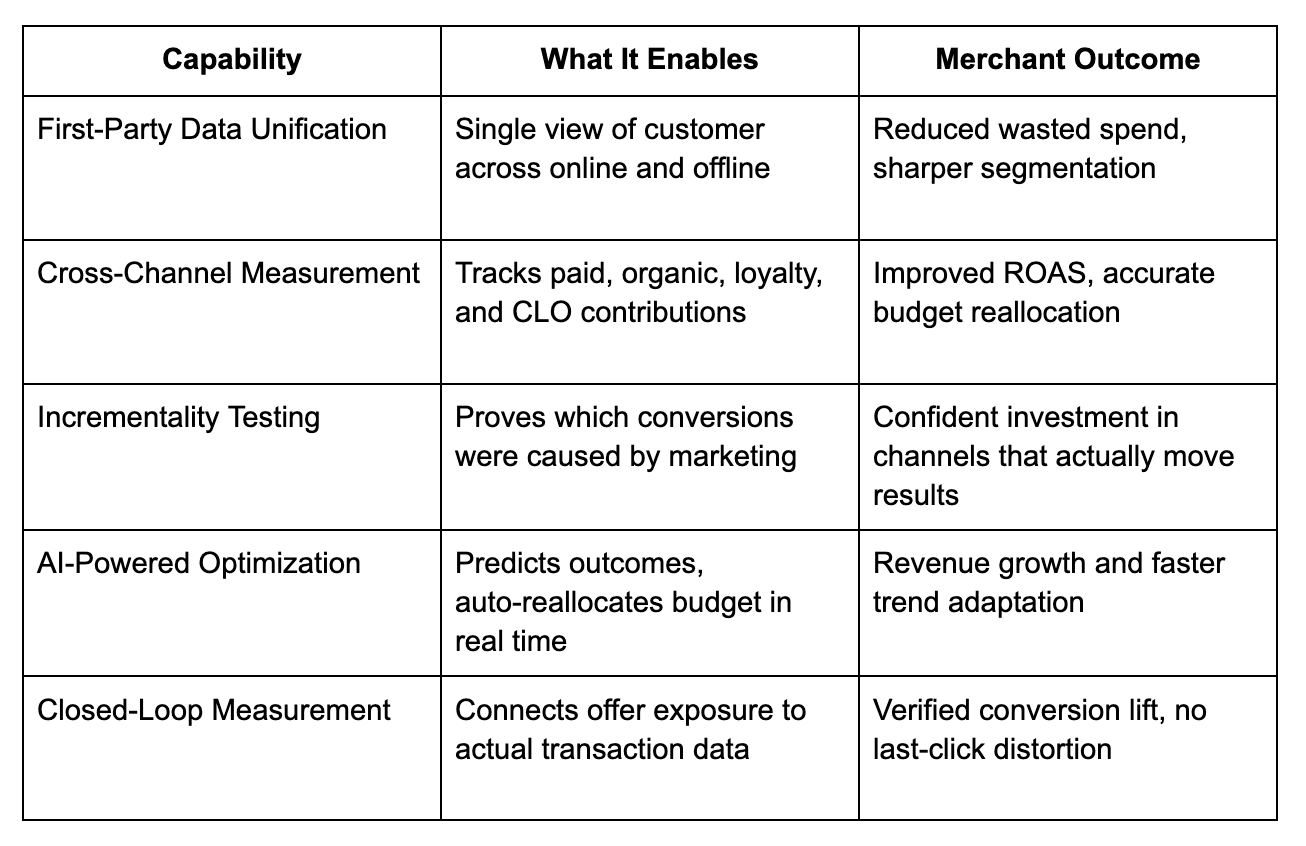
That last row matters more than most merchants realize. The majority of attribution stacks rely on digital proxies (think clicks, pixels, UTM parameters), which fall apart the moment a customer walks into a store or switches devices. Transaction-level data is the only thing that closes that gap reliably.
How to Actually Implement Multi-Touch Attribution
Step 1: Audit Your Data Sources
Before you pick a model, map every channel touching your customer journey, such as:
- Paid media
- Loyalty programs
- Cash back offers
- In-store POS
It’s critical to be honest about what you’re actually capturing versus what you’re assuming here.
- Do you have visibility into in-store transactions, or only digital conversions?
- Are your loyalty program and paid media data sitting in separate platforms that never reconcile?
- Are there channels like cash back offers that are influencing purchases but not showing up in your reporting at all?
Gaps in data coverage become gaps in attribution accuracy, and you can’t fix what you don’t have mapped.
Step 2: Pick the Right Model For Where You Are
The temptation is to jump straight to algorithmic attribution because it sounds the most sophisticated. But a position-based or time-decay model built on clean first-party data will outperform a poorly trained algorithmic model every time.
If you’re just getting started, position-based is a practical choice: it acknowledges that both the first and last touchpoints matter, without requiring heavy data infrastructure.
If you have a longer consideration cycle (think furniture, apparel, or subscription services), time-decay tends to produce more accurate credit distribution because it reflects how customers actually make those decisions. Save the algorithmic model for when you have the transaction volume and the data pipeline to support it.
Step 3: Connect Your Data Across Channels
You can have the right model and clean data sources, but if they’re not talking to each other, you’re going to keep making decisions in silos.
The goal is a single attribution layer that ingests data from every channel: paid media platforms, your ESP, your loyalty program, your POS system, and any rewards demand platforms. For omnichannel merchants, getting offline transaction data into that layer is non-negotiable.
A customer who saw three digital touchpoints and then bought in-store will look like an unattributed walk-in without it. So, start with the highest-volume channels and build from there.
Step 4: Set Baselines Before You Optimize
One of the most common mistakes is starting to act on attribution data before you’ve established what “before” looks like. If you don’t have baseline ROAS targets, CPA benchmarks, and retention rates by channel, you have no way to measure whether the decisions you’re making based on attribution are actually improving performance or just shifting numbers around.
Spend at least 60-90 days collecting data under your new attribution model before making significant budget changes. The first thing you’ll likely notice is that some channels that looked strong under last-touch look considerably weaker under a multi-touch model, and vice versa.
Step 5: Treat It as a Living System
Consumer behavior changes, new channels get added, and the patterns that made your model accurate six months ago may not hold today. Build a quarterly review cadence into your process to check performance and pressure-test whether the model itself still reflects how your customers are actually buying.
Pay particular attention to incrementality. Attribution tells you which channels are getting credit. Incrementality testing tells you which ones are actually causing conversions — a meaningful distinction when you're trying to figure out where to invest more.
A few things that tend to go wrong
- Over-relying on one model and treating its outputs as ground truth
- Leaving offline touchpoints out of the picture entirely
- Building measurement infrastructure on third-party data that won't survive privacy changes
- Optimizing for the metric attribution is easiest to measure rather than the outcome the business actually cares about
Where Rewards Platforms Fit Into Attribution
When a customer redeems a cash back offer, whether it’s a dollar amount or a percentage back, the platform captures that conversion with a degree of certainty that most digital channels can’t match.
With anonymized transaction data from tens of millions of cardholders (roughly $70 billion in annual purchase volume), Kard uses predictive AI and first-party spending data to deliver hyperpersonalized cash back offers to Gen Z and Millennial shoppers.
The same transaction data that powers offer delivery also powers measurement: closed-loop attribution that connects exposure to conversion, and incrementality testing that proves whether the campaign actually changed behavior or just took credit for a purchase that was going to happen anyway.
That incrementality piece is what separates real attribution from flattering attribution. Kard runs holdout groups, matched customers who don’t receive the offer, to isolate the causal effect of each campaign.
Start Building Attribution Infrastructure Before You Need It
When budget pressure comes (and it always does), you need to know exactly where to cut and where to double down. Multi-touch attribution gives you that clarity. A few tips to walk away with:
- Match your attribution model to your actual journey complexity and data maturity
- Don't leave offline touchpoints out.
- Look for measurement partners that close the loop at the transaction level, not the click level.
Ready to see what closed-loop attribution and incrementality testing looks like in practice?
Kard is a good place to start. Request a demo today →
FAQs About Multi-Touch Attribution
Which attribution model is best for retail brands?
It depends on your customer journey and what you're optimizing for. Brands with long consideration cycles and omnichannel touchpoints tend to get the most out of position-based or algorithmic models. If you're earlier in your data journey, linear or time-decay models are a more practical starting point. The most important thing is matching the model to the business objective — acquisition efficiency, conversion optimization, and retention each call for different weighting.
Can multi-touch attribution work without third-party cookies?
Yes, and first-party data actually produces more accurate measurement than cookie-based tracking. Loyalty program data, CRM data, and transaction-level data from card networks don’t have the cross-device fragmentation and ad blocker erosion problems that cookies did. Platforms like Kard are built on this foundation, which makes them well-positioned for a privacy-first measurement environment.