
Proving which campaigns actually drive new demand is still one of the hardest jobs in marketing — especially for subscription, QSR, retail, and grocery brands juggling paid media, offers, and channels. Clicks and conversions roll in, but pointing to what, exactly, drove incremental revenue is difficult.
This is why it’s important to understand how marketing attribution and incrementality differ.
Marketing attribution clarifies where clicks or purchases occur. Incrementality asks whether the marketing tactics used to drive said clicks actually led to a transaction or if they would’ve happened anyway. Both matter, and, in fact, accurate incrementality relies on accurate attribution.
In this article, we’ll break down how the two relate to each other, and to use each method and how combining them can help you increase your marketing ROI, optimize marketing budget, and make smarter growth bets.
Attribution and Incrementality Explained
Put simply, attribution is being able to attribute someone’s behavior to something. Incrementality measures how much that behavior actually changes. As Geoffrey Sanders, a member of Bain's Advisor Network and Head of Digital Marketing at Meta, puts it:
“There’s a fundamental difference between marketing attribution and incrementality. To me, being able to measure something is attribution. Understanding how it changes consumer behavior is incrementality. Often those terms are used interchangeably, but they’re really, really different.”
Though they’re different, the two work hand-in-hand to measure the success of your marketing strategy. Below we’ll cover each one through examples.
Attribution
What it is: This methodology assigns credit across customer journey touchpoints like email and push notifications. Common multi-touch attribution models include first-click, last-click, linear, and time-decay.
Example: Someone might get an email from their bank saying they have a 5% cash back reward at their grocery store that’s about to expire. They see that notification pop up, redeem the offer in-store.. Attribution helps you decide which channels deserve budgeting.
How to measure it
- Collect customer-level interaction data, like paid media impressions, email opens, push notification opens (and how long they viewed it), putting items in their cart, and other in-app behavior.
- Define the conversion event, for example, opening the email about the offer and making a transaction.
- Choose an attribution model. You might opt for first touch, last touch, or multi-touch attribution. However it’s important to note that:
- Last-click attribution overvalues the final touchpoint in a customer's journey and makes many unfounded assumptions about marketing impact.
- Multi-touch attribution (MTA) estimates incremental impact through models rather than direct measurement.
- Marketing mix models (MMM) use statistical correlations to optimize spending across tactics, but can't track individual behaviors..
- Analyze performance.Ideally, you reallocate spend to the touchpoints that drive the highest conversion — but that’s determined by incrementality, which we’ll get into next.
Incrementality
What it is: Incrementality measures causality. It asks: Did this campaign actually drive behavior, or would consumers have behaved the same whether they saw an ad, notification, or pop-up?
Example: A quick service restaurant (QSR) brand runs a promotion offering 10% cash back through a popular fintech platform, sending a push notification through the app.
But instead of blasting it to all users, the marketer randomly withholds the offer from 20% of the group as a control. After two weeks, the test group (80% of people who got the push notification) shows a 12% higher visit rate and 8% higher average order value, but the control group’s behavior remains flat.
The difference in visit rate and AOV between the two groups represents incremental lift — orders seemed to only occurred because of the promotion.
How to measure it
- Define the behavior you’re trying to drive.
- Select an audience that’s likely to respond to your campaign. Tip: Use the data you gathered in the attribution phase. Did a customer who’s in the Gen Z demographic respond to your email ad or push notification?
- Randomly split your audience into test and control groups.
- Launch the campaign.
- Measure lift (not conversion) between the test and control groups.
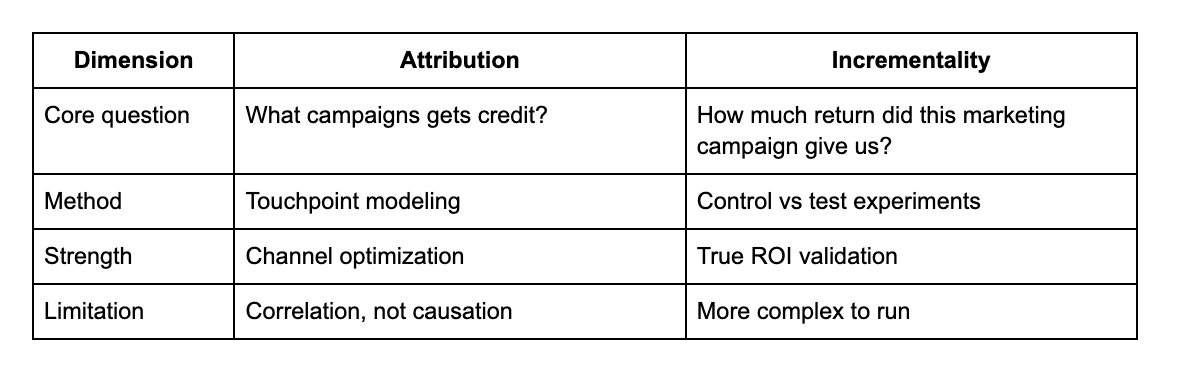
The Power of Combining Incrementality and Attribution
True attribution shows where conversions come from, enabling marketers to shift their marketing budgets toward high-performing channels and cut waste. For marketers managing millions in paid media and incentives, this efficiency directly impacts margin.
Attribution alone can overstate ROI by rewarding channels that capture demand rather than create it. This is where incrementality plays a key role. By holding out control groups, you can validate not only how many conversions could be attributed to your campaigns, but how much return you actually got as a result of running them (versus not running them at all).
In other words, attribution models guide optimization decisions but incrementality confirms true lift.
This combination delivers a more defensible view of ROI for leadership. Plus, maturity in measurement best practices also correlates with growth.
In a Bain report, companies that allocated more funding and time to digital marketing experimentation were able to generate revenue growth and an increase in website traffic. As a result of these investments, high-growth firms had 30% more confidence in their marketing attribution and measurement methods.
What Happens When You Don’t Measure Incrementality?
A retailer running a loyalty program promo might see a 15% increase in redemptions through attribution, but incrementality testing may reveal that only 6% was truly incremental spend — the rest coming from customers who would’ve purchased anyway.
Without measuring incrementality, it’s tough to protect margin and prevent over-rewarding loyal but non-incremental customers.
QSR brands face similar challenges. A mobile app promotion tied to geofenced lunch hours may show strong attributed ROAS, yet lift testing can isolate whether store visits increased beyond baseline — often revealing 5 to 10% true lift during seasonal campaigns.
As retail media networks grow rapidly, merchants need incrementality to validate sponsored placements and on-site ads.
That’s why more and more brands are turning to commerce media. Commerce media is able to link ad spend directly to customer purchases, and attribution similarly assigns credit to customer touchpoints. It’s all the more important to add attribution to your marketing plan.
Did you know? Kard is the first independent commerce media network. Using predictive AI and first-party transaction data from millions of Gen Z and Millennial shoppers, Kard powers hyperpersonalized offers that scale customer acquisition. By linking brand exposure directly to verified online and in-store purchases, Kard proves incremental impact at scale.
How to Implement Marketing Attribution and Incrementality & Best Practices
So now that you understand what attribution and incrementality are and how they function, it’s time to speak more practically: how do you actually implement these frameworks and what are best practices you should keep in mind?
- Clearly define your objectives. What does success look like if you were to implement attribution and incrementality? Are you hoping to understand which segmentation group is most buying your product? Or, do you want to better understand if your marketing created a sales lift?
- Design incrementality tests with proper control groups and sufficient sample sizes to create valid statistics. Not doing so could skew your results or generate ones that aren’t so representative of your audience.
- Use the data you gather in your testing to modify budgets for marketing campaigns. For example, if your results showed that younger customers tend to be higher spenders thanks to a reward offer you targeted them with, you might want to consider increasing campaign reward spending for this demographic of shoppers. This process could be part of your rewards program ROI strategy, too.
By using a more targeted approach, a large North American retailer experienced a boost of about 3% in annualized margins. Smart and targeted promotions streamline the customer journey, help increase your sales, and help you optimize your campaign spending.
How Kard Can Help Your Implementation
Kard provides cash back offer solutions that help merchants reach Gen Z and Millennial customers and measure campaign performance. In a market where Gen Z digital natives are dictating what influencing the future of shopping will look like, it’s critical to start measuring which marketing methods influence their behavior.
That’s why every campaign we run gets analyzed through an incremental lift study, where we:
- Create statistically equivalent groups: Dividing audience into test (80%), control (10%), and reserve (10%) segments
- Expose only the test group to your offers: The control group receives no marketing intervention
- Measure the difference in outcomes: Compare key metrics between groups to reveal the true incremental impact
This approach allows you to measure meaningful business outcomes like conversion rates, spend rates, average order values, and transaction frequency while controlling for all other variables. And the most valuable outputs from these studies are efficiency metrics that quantify return on marketing investment:
- Incremental Return on Ad Spend (iROAS): How much incremental revenue is generated for each dollar invested
- Incremental Cost per Acquisition (iCPA): How efficiently your campaign acquires truly incremental customers
Our recent incremental lift studies across various verticals have revealed compelling strategic insights:
- Transportation/Delivery Service: A campaign focused on new customer acquisition drove a 134% lift in conversion rate, demonstrating the power of rewards in motivating first-time purchases.
- Health/Wellness Retailer: Despite targeting existing active customers, the campaign generated over 10x iROAS - proving that even loyal customers can be influenced to spend more when presented with the right offer.
FAQs About Marketing Attribution and Incrementality
What's the key difference between marketing attribution and incrementality?
Marketing attribution tells you which particular channels lead to a conversion, while incrementality measures causality (did a campaign or offer drive a purchase that would have happened anyway?) and impact (how much did behavior change as a result of the campaign).
Which should I use first?
Attribution should come first because it’s used to measure incrementality. In other words, to understand if a campaign truly led to a conversion, you first need the conversion data — who purchased what, when, and where? Incrementality essentially tries to answer why someone purchased.
How do I run an incrementality test?
- Create statistically equivalent groups by dividing your audience into test, control, and reserve segments.
- Provide offers only to the test group – the control group doesn’t receive anything.
- Measure the impact of the offer. Did the test group purchase significantly more than the control group?
What results can I expect?
Attribution can help you understand which marketing investments, like campaigns and rewards, yielded the most new clients and who these clients specifically are (Gen Z, Millenials, etc.). And when paired with incrementality, you can formulate targeted campaigns to help you reach your sales goals.