A consumer’s experience begins way before they ever make a purchase because — well, you need to get them to make a purchase. As such, your marketing strategy plays an important role in the customer journey.
And omnichannel lifecycle marketing is where you can get the most bang for your buck.
It’s the strategic and coordination of messaging, offers, and timing across all customer touchpoints throughout the entire customer journey, and is integrated across different media. Unlike multichannel marketing, which is more of a saturation strategy, omnichannel marketing seeks to send customers the right message via the right channel at the right moment.
In this guide, we’ll explain more about what omnichannel marketing is, who it’s for, and how to best use it.
6 Key Stages in Omnichannel Lifecycle Marketing (and How to Carry Them Out)
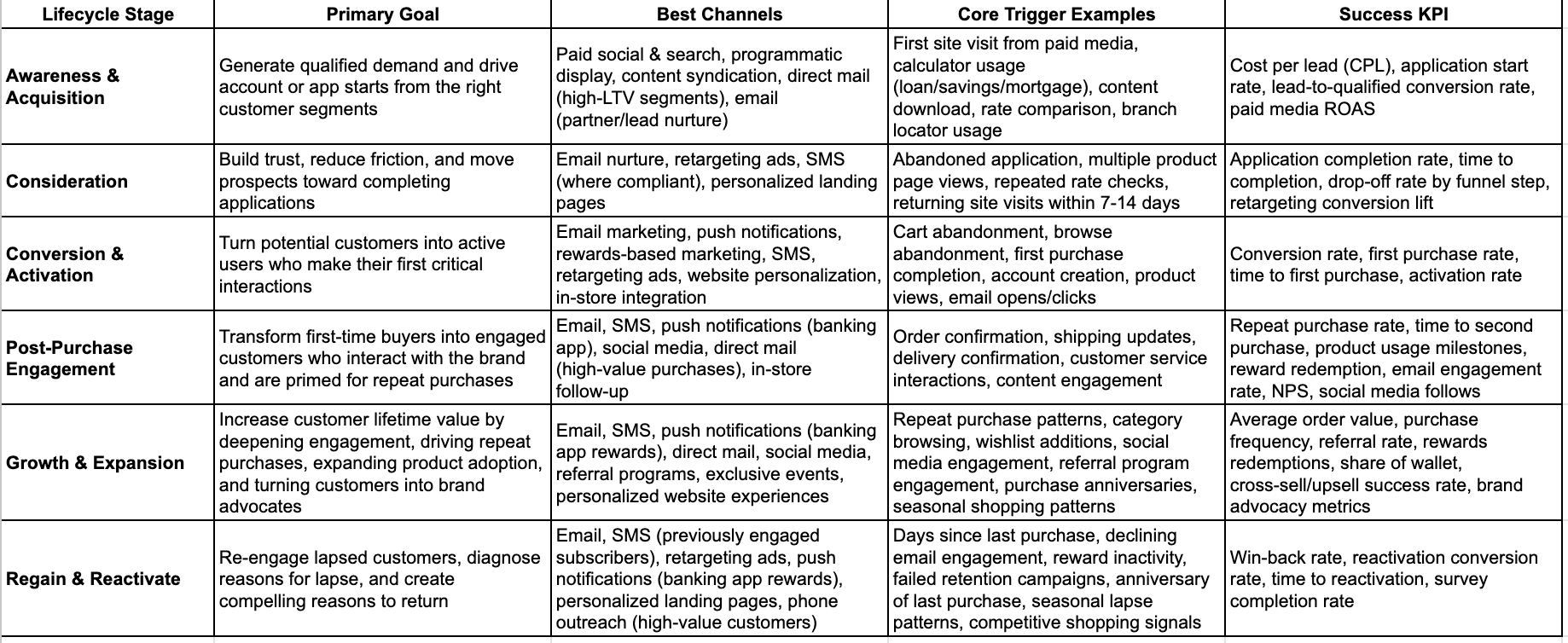
Below is a stage-by-stage lifecycle framework with clear objectives, triggers, channels, and key performance indicators (KPIs).
1. Awareness & Acquisition
Primary objective: Generate qualified demand and drive account or app starts from the right customer segments.
Recommended channel mix:
- Coordinate paid social & search
- Programmatic display
- Content syndication
- Direct mail (for high-LTV segments)
- Email (partner or lead nurture)
Behavior-based triggers:
- First site visit from paid media
- Calculator usage (loan, savings, mortgage)
- Content download or rate comparison
- Branch locator usage
Success KPIs:
- Cost per lead (CPL)
- Application start rate
- Lead-to-qualified conversion rate
- Paid media ROAS
2. Consideration
Primary objective: In this stage, you want to prioritize building trust, reducing friction, and moving prospects toward completing their applications.
Recommended channel mix:
- Email nurture
- Retargeting ads
- SMS (where compliant)
- Personalized landing pages
Behavior-based triggers:
- Abandoned application
- Multiple product page views
- Repeated rate checks
- Returning site visits within 7-14 days
Success KPIs:
- Application completion rate
- Time to completion
- Drop-off rate by funnel step
- Retargeting conversion lift
Nudging users through the lifecycle helps maintain potentially lost revenue.
3. Conversion & Activation
Primary objective: To coordinate turning potential customers into active users who make their first critical interactions with the institution.
Recommended channel mix:
- Email marketing
- Push notifications
- Rewards-based marketing
- SMS
- Retargeting ads (social and display)
- Website personalization
- In-store integration
Behavior-based & time-based triggers:
- Cart abandonment
- Browse abandonment
- First purchase completion
- Account creation
- Product views
- Email opens/clicks
Scenario: First-Time Visitor to New Customer
A person browses your website, adds items to their cart but abandons it. Here's how omnichannel marketing converts and activates them:
Immediate conversion tactics:
- An abandoned cart email arrives within 2 hours with product images and a gentle reminder
- Retargeting ads appear on Instagram and Facebook showing the exact items they viewed
- A push notification in their banking app offering 15% cash back on their first purchase
- SMS message 24 hours later reminding them of their offer
Cross-channel coordination: All touchpoints share data to prevent duplicate messaging. The goal is moving them from converted once to actively engaged with the brand across multiple channels.
4. Post-Purchase Engagement
Primary objective: Transform first-time buyers into engaged customers who interact with the brand, provide feedback, and are primed for repeat purchases.
Recommended channel mix:
- SMS
- Push notifications from banking app
- Social media
- Direct mail (for high-value purchases)
- In-store follow-up
Behavior-based triggers:
- Order confirmation
- Shipping updates
- Delivery confirmation
- Customer service interactions
- Content engagement
Success KPIs:
- Repeat purchase rate
- Time to second purchase
- Product usage milestones
- Reward redemption
- Email engagement rate
- Net Promoter Score
- Social media follows
Scenario: Activating the New Customer
After someone makes their first purchase, the activation phase begins to turn this one-time buyer into an engaged customer:
- Welcome series triggers across channels: a thank you email, tips on caring for their purchase, and a 10% cash back offer on their next purchase
- In-app message encouraging account creation to track their order and save favorites
- Post-purchase SMS with tracking link and invitation to follow on social media
- Email a week later asking for product review, offering reward points for completing it
- Personalized recommendations via email based on their first purchase
Keeping customers engaged is crucial because it costs less to retain them than to reacquire them.
5. Growth & Expansion
Primary objective: Increase customer lifetime value by deepening engagement, driving repeat purchases, expanding product category adoption, and turning satisfied customers into brand advocates.
Recommended channel mix:
- SMS
- Push notifications for rewards (in banking app)
- Direct mail
- Social media (organic and paid)
- Referral programs
- Exclusive events (virtual and in-store)
- Personalized website experiences
Behavior-based triggers:
- Repeat purchase patterns
- Category browsing
- Wishlist additions
- Social media engagement
- Referral program engagement
- Purchase anniversaries
- Seasonal shopping patterns
Success KPIs:
- Average order value
- Purchase frequency
- Referral rate
- Rewards redemptions
- Share of wallet
- Cross-sell and upsell success rate
- Brand advocacy metrics (reviews, social shares)
Scenario: Expanding a Loyal Customer's Engagement
A customer has made three purchases over six months, always buying dresses. Here's how to grow their relationship:
- Personalized email showcasing complementary categories like shoes and accessories based on their dress purchases
- SMS alert for early access to new dress collections before general release
- Push notification about a 5% cash back offer on the dress category (or another new category the customer might like based on previous purchases)
- Direct mail lookbook featuring complete outfits, styling their favorite dress category with other products
- Referral incentive via email: give friends a discount, earn rewards for each successful referral
- Exclusive invitation to virtual styling session or in-store VIP shopping event
- Birthday email with special offer and product suggestions based on purchase history
Now, your goal should be to increase customer lifetime value by cross-selling and upselling. Lifecycle-driven cross-sell should not be overlooked, especially as 45% of Gen Z customers expect personalized experiences while shopping.
6. Regain and Reactive Lapsed Customers (with a detailed example)
Primary objective: Re-engage customers who have stopped purchasing or interacting with the brand, diagnose reasons for lapse, and create compelling reasons to return with relevant offers and messaging.
Recommended channel mix:
- SMS (for previously engaged subscribers)
- Retargeting ads (social and display)
- Push notifications for rewards (in banking app)
- Personalized landing pages
- Potentially phone outreach for high-value customers
Behavior-based triggers:
- Days since last purchase
- Declining email engagement
- Reward inactivity
- Failed retention campaigns
- Anniversary of last purchase
- Seasonal lapse patterns
- Competitive shopping signals
Scenario: Winning Back a Lapsed Customer
A customer made regular purchases for eight months but hasn't bought anything in four months and email engagement has dropped to zero.
Stage 1: Soft Re-engagement (at 60 days inactive)
- Friendly email with subject line “We miss you” featuring their favorite product categories
- Retargeting ads on social media showing new arrivals in categories they previously purchased
Tip: No aggressive discounting yet, focus on relevance and newness.
Stage 2: Value Proposition (at 90 days inactive)
- Email with “Come back” incentive: 10-15% cash back offer, discount code, or free shipping
- SMS (if they previously engaged via text) with exclusive offer
- Direct mail postcard for higher-value lapsed customers with personalized product recommendations
- Retargeting ads shift to promotional messaging
Stage 3: Win-Back Campaign (at 120 days inactive)
- Stronger incentive email: larger cash back offer or gift with purchase
- Survey email asking why they stopped shopping, with incentive for completion
- Push notification on banking app for a cash back reward for a new category
- Personalized landing page when they click any link, acknowledging their absence and showcasing what’s new
Stage 4: Last Attempt (at 150+ days inactive)
- Final email with best offer and clear expiration date
- Phone call for previously high-value customers offering personal shopping assistance
- Preference center link allowing them to update communication frequency or opt down rather than out entirely
If they return:
- Welcome back message acknowledging their return
- Post-purchase survey to understand what brought them back
- Immediate enrollment in more frequent engagement cadence to prevent re-lapse
- Personalized recommendations based on both old and new purchase behavior
Always keep in mind that reactivating existing customers is less expensive than acquiring new ones.
Automation platforms trigger messages based on customer behavior and lifecycle stage, ensuring timely, relevant communication at scale. Meanwhile, send-time optimization fine-tunes the timing of these messages, using machine learning and data insights to determine the optimal moment for each individual to receive the communication, increasing the chances of engagement.
The Strategic Value of Omnichannel Lifecycle Marketing
Unified omnichannel lifecycle orchestration significantly boosts both customer engagement and retention and business performance and attribution. By delivering personalized, timely messages across different channels (email, SMS, push, in-app), financial marketers can keep customers engaged at every stage of their journey, resulting in higher retention and increased lifetime value (LTV).
On the business performance side, lifecycle marketing drives more efficient customer acquisition by optimizing customer acquisition cost (CAC) through better targeting and automation. With a unified data approach, marketers can focus their spend on high-value prospects and reduce CAC.
Additionally, real-time tracking and closed-loop measurement allow for accurate incrementality measurement, helping marketers understand which touchpoints truly drive conversions. This clarity in attribution enables more informed decision-making, optimizing budget allocation and improving ROI. Financial institutions leveraging a closed-loop system see 20-30% better ROI benchmarks than those with fragmented or delayed reporting.
How Does Omnichannel Lifecycle Marketing Impact Customer Engagement and Retention?
Being omnipresent throughout the customer journey comes with its benefits. It drives key customer-facing outcomes by delivering personalized, behavior-triggered messages across channels (email, SMS, push, in-app) that enhance activation, transaction frequency, and retention.
By sending the right message at the right time, you can accelerate time-to-first-transaction and increase order value.
At the same time, consumers can grow tired of messaging, even when it’s personalized. To avoid messaging fatigue, you want to utilize dynamic segmentation so that messaging is as personalized as possible to each user’s purchase behavior, history, and lifecycle stage.
This process can lead to higher engagement and repeat purchases. For example, sending onboarding tips to new users or personalized offers to high-value, loyal customers helps keep them engaged. Frequency capping also helps prevent message fatigue by limiting over-communication, which reduces the risk of unsubscribes and increases the longevity of customer relationships.
To make sure personalized messaging and segmentation are working for you, track the following 4 metrics:
- Activation rate and time-to-first-value
- Transaction frequency and repeat purchase rate
- Re-engagement rate for dormant users
- Churn rate and retention cohort curves
Core Components of Omnichannel Lifecycle Marketing: Data, Technology, and Automation
Effective omnichannel lifecycle marketing efforts require a robust technology stack that integrates data management, automation, messaging execution, and performance measurement. The most important parts of your stack include:
- Customer Data Platforms (CDPs), which unify customer data across touchpoints, enabling real-time segmentation and personalized targeting, which accelerates campaign launches and increases conversion rates. The best CDPs come with identity resolution features, which ensure you’re targeting the right person with the right message across devices and channels, improving cross-channel engagement and customer retention.
- Automated marketing platforms are also important because they drive orchestration, automating workflows for timely, behavior-driven messaging via email, SMS, push notifications, and in-app messages. These platforms increase operational efficiency, allowing marketers to scale personalized communications and reduce manual intervention, leading to faster execution.
- Performance tracking tools measure campaign effectiveness across channels, providing insights into customer journeys and touchpoint performance. Attribution models help determine which interactions drive conversions, while incrementality testing reveals the true impact of marketing efforts beyond baseline activity. These capabilities enable data-driven optimization, budget allocation decisions, and clearer ROI demonstration to stakeholders.
- Consent and preference management. Centralized systems manage customer privacy preferences, opt-ins, and opt-outs across all channels to ensure compliance with regulations like GDPR, CCPA, and CAN-SPAM. These platforms maintain audit trails, honor communication frequency preferences, and provide customers with self-service preference centers. Proper consent management builds trust, reduces legal risk, and ensures marketing messages reach only engaged, opted-in audiences, improving deliverability and campaign performance.
Together, these components form a cohesive stack that drives personalized, consistent customer experiences across channels, reduces friction, and maximizes lifetime value.
Targeting and Personalization Essentials You Need to Use
As we’ve mentioned, personalization drives customer engagement, retention, and positive customer experiences. Personalization is best carried out with first-party data directly linked to transactions — that way, you’re not guessing what a customer’s preferences or interests are, you know.
The great thing about first-party data is that it can be utilized in multiple ways, not just to personalize messaging or rewards.
First-party data should be coupled with zero party data like survey responses to enable customer segmentation, dynamic content, and recommendation engines. Linked, these datasets fuel precision targeting.
Some precise targeting tactics include:
- Browse abandonment retargeting with viewed products
- Cart abandonment recovery with incentive escalation
- Next-best-action recommendations based on purchase history
- Lapsed customer win-back with personalized offers
- Cross-sell and upsell triggers post-purchase
Retailers have found that apps that trigger rewards based on consumer locations created a 10% lift in sales. If retailers have this strategy down, imagine what you and your card could do with the same data, especially if your card provides cardholders with a large ecosystem of varied offers and merchants.
Precise and targeted interactions with consumers can help lower acquisition costs by reducing wasted impressions and increasing conversion rates through relevant messaging. In fact, research shows that 65% of customers view targeted promotions as a top reason to purchase.
Why Incrementality Testing is Non-Negotiable
Attribution alone can over-credit always-on channels. Incrementality testing with holdout groups reveals what would have happened without marketing, ensuring optimization focuses on true lift, not vanity metrics.
Core measurement methods include:
- Multi-touch attribution models: Journey-level credit assignment
- Incrementality testing: Randomized holdout groups to measure true impact
- Lift analysis: Test vs. control cohort performance
- Marketing mix modeling (MMM): Scaled, top-down budget optimization
Here’s a deeper look at how we do incrementality testing on our own cash back offer campaigns at Kard.
Omnichannel Lifecycle Marketing Challenges and Solutions
Omnichannel lifecycle marketing is a great strategy to use to hold onto customers, but it also comes with its challenges. Here are some solutions to conquer common issues:
- Challenge 1: Data Fragmentation → Solution: CDP + Identity Resolution. When customer data lives across core banking, CRM, and channels, lifecycle marketing breaks. A CDP with identity resolution unifies profiles in real time.
- Challenge 2: Privacy & Consent Management → Solution: Compliant Consent Workflows. Omnichannel fails if consent isn’t respected across touchpoints. GDPR/CCPA-compliant consent workflows and preference centers centralize permissions. Marketers reduce compliance risk while improving opt-in quality, often increasing engaged, permissioned audiences, which also leads to better deliverability, higher engagement, and defensible personalization in audits and regulator reviews.
- Challenge 3: Channel Fatigue & Deliverability → Solution: Frequency Capping + Optimization. Over-messaging erodes trust and damages sender reputation. Frequency capping, suppression logic, and send-time optimization prevent burnout.
- Challenge 4: Integration Complexity & Speed → Solution: API-First Platforms. Slow, brittle integrations stall lifecycle programs. API-first platforms with pre-built CRM and analytics connectors accelerate execution.
Best Practices to Optimize Omnichannel Lifecycle Marketing
As with any great platform, its optimization is a continuous discipline. This is best done in two parts: 1) strategic planning and 2) running optimization frameworks like A/B testing.
Simple Strategic Planning Checklist
Executing great ideas requires equally great planning. Here’s a quick checklist to follow as you plan to optimize your omnichannel lifecycle marketing integration:
- Define success KPIs per lifecycle stage.
- Establish baseline metrics before launch.
- Map personas and segment audiences.
- Audit current channel performance and identify gaps.
- Diagnose funnel conversion rates and drop-off points.
- Set realistic targets based on industry benchmarks.
Quick Optimization Framework
Iteration is necessary when working on optimizing your omnichannel integration. Here’s a 5-step optimization loop you can follow to optimize your integration:
- Prioritize tests by expected impact and ease.
- Run A/B or multivariate experiments with proper control groups.
- Measure lift and confirm statistical significance.
- Implement winning variants and document learnings.
- Use next-best-action models to personalize treatment per user segment. Emphasize testing creative, send timing, channel selection, and audience targeting as high-yield levers.
Integrating Kard with Omnichannel Lifecycle Marketing
Optimization doesn’t have to be difficult. Kard's card-linked offers (CLO) platform is a strategic layer within the omnichannel lifecycle stack. Kard integrates with CRMs, CDPs, and marketing automation platforms via API-first architecture to enable reward-based offers that drive high-intent customer actions. Its real-time transaction verification for closed-loop attribution eliminates probabilistic guesswork and speeds optimization cycles.
Kard’s CLO platform provides users with offers like:
- Activation incentives (e.g., "Earn $10 back on your first card purchase")
- Growth campaigns (e.g., merchant-funded offers to drive category spend)
- Win-back offers (e.g., personalized cashback for lapsed users)
With Kard, fintechs have been able to reach a 44% retention rate increase and an increase in average customer value by 163%.
Why Omnichannel Lifecycle Marketing Matters
It provides cohesive customer experiences, proves ROI, and creates a durable competitive advantage. For FIs, fintechs, and banks, orchestrated lifecycle journeys increase customer retention and engagement while tying acquisition, activation, and growth to deliver lifts in conversion, cross-sell, and lifetime value. Data-driven personalization across channels turns fragmented touchpoints into a coherent, trust-building relationship.
Early adopters who invest now in unified data, automation, and closed-loop measurement see exponential gains over time thanks to faster testing, smarter personalization, and sustained growth that competitors can’t easily replicate. Brands that act now win later.
Explore Kard’s CLO platform integration or schedule a consultation to design a high-impact omnichannel strategy.
FAQs About Omnichannel Lifecycle Marketing
What is the difference between omnichannel and multichannel lifecycle marketing?
Multichannel marketing runs parallel campaigns across channels (email, SMS, push) without unified customer context or coordination. Omnichannel lifecycle marketing unifies customer data, orchestrates messaging across channels based on real-time behavior, and ensures consistent, personalized experiences throughout the journey.
Which KPIs best prove ROI across the lifecycle?
Track stage-specific KPIs: activation rate and time-to-first-transaction (activation), transaction frequency and repeat purchase rate (growth), customer churn rate and win-back success rate (retention).
What attribution model should we start with?
Start with multi-touch attribution models that credit multiple touchpoints in the customer journey map: linear (equal credit to all touches), time-decay (more credit to recent customer interactions), or U-shaped (emphasizes first and last touch). As you mature, layer in incrementality testing with randomized holdout groups to measure true lift and validate attribution accuracy.
How can rewards-based campaigns fit into the lifecycle without causing fatigue?
Use rewards strategically at high-intent moments: onboarding incentives to drive first transaction, growth offers to increase purchase frequency in specific categories, and personalized win-back offers for lapsed customers. Apply frequency capping (e.g., max 1 offer per customer per week) and suppression logic to avoid over-messaging.

.jpg)
